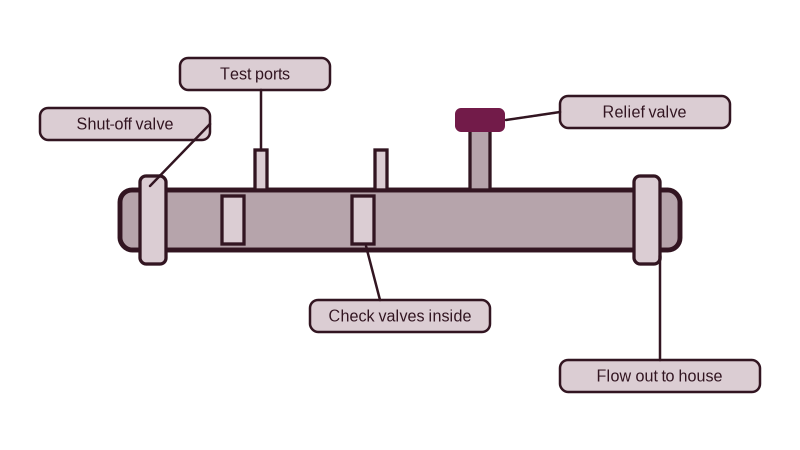
You do not test a backflow device yourself in any practical sense. The reading needs a test kit, a trained tester and a form that goes to whoever supervises your water supply. What you can do is know which device you have, arrange the visit and keep the paperwork. If you are starting from the Conejo Plumbing Pros home page, this guide covers the test, the permit questions that usually sit beside it, and the order to do things in.
What is a backflow test looking for?
The test confirms that the device guarding the public water supply still blocks dirty water from flowing backwards. With the valves closed in sequence and a gauge connected to the test ports, the tester reads the pressure differences across each check valve and the relief valve. Any part that cannot hold gets fixed or swapped out, then the device is tested a second time.
The device is installed wherever contamination could occur: a lawn irrigation system, a fire sprinkler line, a pool fill, a hose bib fitted with a vacuum breaker or a commercial setup. A garden hose left in a bucket or pool is a classic example of how pool water, fertilizer or soap could be drawn back into drinking water if pressure drops on the street.
Homes on the Conejo Valley's hillsides often have irrigation systems on large sloped lots, and that is the leading reason a household ends up owning a backflow assembly at all. A small hose-bib vacuum breaker is a different, simpler device and is generally not tested the same way.
Who is allowed to do backflow testing?
Testing is done by a person who holds a backflow tester qualification that the water supplier accepts, not by any handy person. Which qualification and which paperwork depends on the supplier, so ask the supplier that bills you what it requires before you book anyone. Some plumbers carry the qualification and some tradespeople only test.
Your first step is to find out who supplies your water, because the answer differs around the valley. Westlake Village and Agoura Hills sit in a different service pattern from Thousand Oaks, and homes in Hidden Valley may rely on private wells. Check the bill or ask the city which provider applies to your street rather than assume.
Ask the tester whether they submit the report to your supplier or hand it to you to send. A test that nobody filed can leave the account flagged, even though the device passed. Keep a copy of every report with your home records, because a future buyer or the supplier may ask for the history.
How do you arrange a backflow test?
Find the device first. Look near the water meter, along the irrigation supply line or beside the house for a brass or bronze assembly with two shut-off handles and small test ports, usually sitting above ground. Photograph it, note any tag, then ask a plumber or tester for a test and give them the photo and your address.
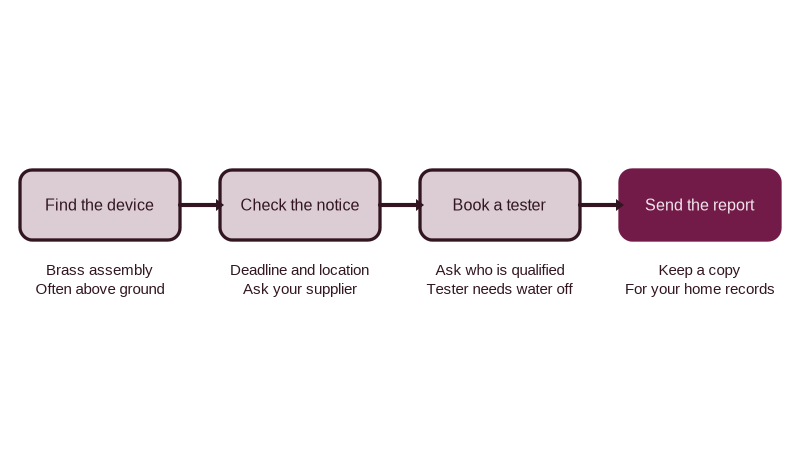
A notice from the water provider usually triggers the process, so look for a letter or door hanger that names a deadline and the device location. If you have not received one but have an irrigation system or fire line, ask the supplier whether your property is on its list. Waiting for a deadline to pass can add late charges or a service interruption.
For the visit, the tester will turn the irrigation off briefly and may need water off for several minutes. Clear access around the device, mow back overgrown plants and make sure gates are unlocked. If the device is in a box below ground level, it may need to be raised or reworked before it can be tested, and that is a plumbing job. For the money side, start with what a plumber costs, and see our note on backflow prevention testing.
How do you get a plumbing permit?
Apply to the building office serving your address. In the city of Thousand Oaks that is City of Thousand Oaks Building and Safety, in Westlake Village it is City Hall, and in unincorporated areas such as Lake Sherwood and Hidden Valley it is the Ventura County Resource Management Agency. Describe the job, pay the fee and wait for approval before work starts.
Ventura County's Resource Management Agency lists a counter at 800 S Victoria Ave in Ventura, open 8:00 AM until 4:00 PM on Monday, Tuesday, Wednesday and Friday and 9:00 AM until 4:00 PM on Thursday. Confirm that before you drive, since counter hours and online options change.
Not every job needs a permit, and the office decides, not an article. Replacing a faucet usually does not, but replacing a water heater, moving gas piping, rerouting drains or repiping a house commonly does. A homeowner can ask the office directly which category the job falls in. If a plumber is doing the work, the plumber normally handles the application and you sign off.
How do you fill out a plumbing permit and draw plans?
The permit form asks for the address, owner, contractor details if any, a description of the work and the fixtures involved. Describe the job in plain terms, for instance "swap gas water heater, same spot", and list fixture counts if you are adding bathrooms. Honest, specific descriptions get approved faster than vague ones.
Whether drawn plans are needed depends on the scope. A water heater swapped for an equivalent unit often needs none, while adding a bathroom, moving a kitchen or a larger repipe may need a simple plan. The office tells you what it wants. A plan can be a neat sketch of the home showing pipe runs, sizes, fixtures, the shut-off valve and where the water heater sits.
Do not guess dimensions. Measure the room, show where the main line enters, and mark any existing gas line. Ask the office for its checklist and follow it item by item. If a plumber is drawing the plans for you, ask to see them before they are filed, because errors in the description can slow the inspection.
What happens at the inspection?
An inspector visits when the work reaches a stage the permit lists, often a rough-in before walls close and a final once fixtures are set. The inspector checks that the pipe, supports, venting, valves and safety devices match the permit. If something is off, a correction notice lists it, and you book a re-inspection.
Keep the work visible and reachable up to the moment the inspector has seen it. Covering pipe early is the single most common cause of a failed rough inspection. Have the permit card on site, water on for any pressure test, and an adult available to let the inspector in.
The final permit inspection for an irrigation or fire line often includes backflow assemblies, and the test report joins that file. If a device is replaced as part of a repipe, the final inspection and the test report both matter, so ask the plumber to plan both visits.
When should you hire someone instead?
Hire someone when the job touches gas piping, the main supply, a water heater replacement, drains inside walls or anything the building office says needs a permit. Hire also when you lack a test kit, which is true of nearly every household for backflow testing. A plumber can handle the permit, the work and the inspection visit in a single run.
If you smell gas, get outside and contact SoCalGas at 1-800-427-2200, plus 911 if you see danger. Never adjust gas piping while sorting out permits. Describe the job on the quote form, and we will forward the request to plumbing businesses in the valley. Staff review the form on weekdays from 9am until 5pm.
Common questions
Does a backflow device get tested annually?
Many water suppliers request yearly testing for devices guarding against serious hazards, but the schedule and the list of devices come from your supplier. Read your latest notice or ask the provider named on your bill. A new assembly is normally tested at installation, then on the supplier's schedule afterward.
How long does a backflow test last?
A single residential assembly usually needs a short visit, often under an hour, with extra time if parts need replacing. Access matters most. A clear, reachable assembly is quick, while one buried in a flooded valve box or hidden behind plants can double the visit. When you book, request an estimate from the tester.
What if my backflow device fails?
The tester will usually name the failed part, such as a check valve or relief valve, and a plumber can rebuild or replace it. After that the device is tested again and the report goes to the supplier. You may have a deadline to complete this, so ask the supplier how long you have.
Can I pull the permit myself?
Many building offices accept owner applications for work on an owner's own home, though the rules and what you must sign differ, and certain work, gas especially, is often better handled by a plumber. Ask the building office what it allows for your address and what responsibility you accept before you apply.