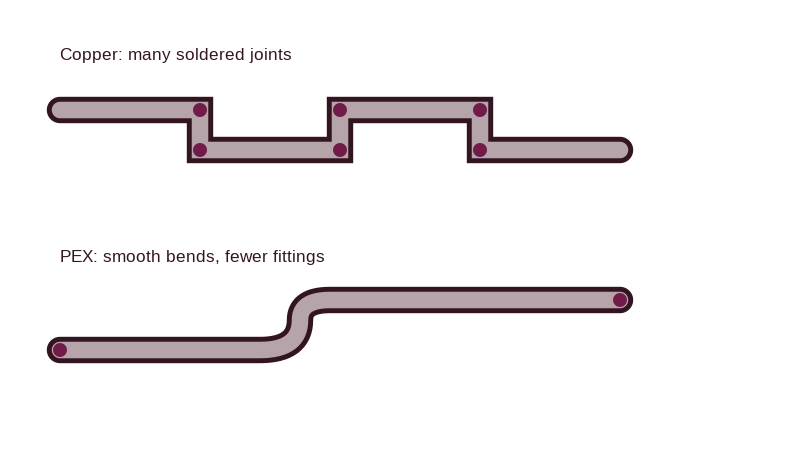
For most whole-house jobs, PEX is the cheaper and faster choice, while copper is the older, harder and longer-proven one. PEX is flexible plastic tubing, and it threads through walls with fewer joints. Copper is rigid metal that lasts for decades but costs more in material and labor. If you are weighing a repipe of your house, the sections that follow compare the two on price, flow, lifespan and cold weather, and flag where each can go wrong.
Does PEX or copper cost less?
PEX usually costs less, for both tubing and labor, since it curves around corners and needs far fewer fittings than copper, which is cut and joined at every turn. Copper prices also follow the metal market. Bids differ by plumber and house, so no figure appears here, and a written quote is the only number to trust.
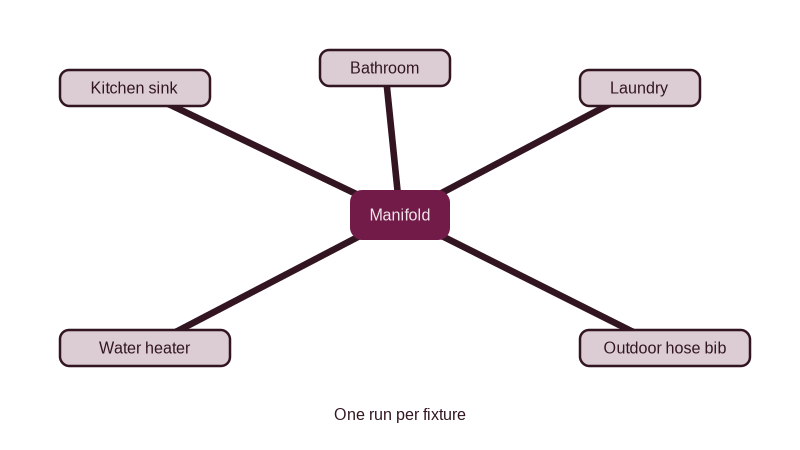
It helps to know where the saving comes from. A copper repipe means soldering many joints, slow work in cramped attic and wall spaces that adds hours. A PEX run is often a single long length reaching each fixture from a central manifold, so the plumber spends less time and cuts fewer holes in drywall.
The gap is not always large, though. Permit fees, drywall repair, painting and a new pressure regulator or shut-off valves cost the same either way. Ask each bidder to price both materials on the same scope so you are comparing like with like. Our repipe cost guide lists what else goes into a bid.
How does flow compare in the same size pipe?
At equal nominal size, copper has a slightly wider bore than PEX, which lets a half-inch copper line move a little more water than a half-inch PEX one. In a typical house the difference is rarely noticeable, because pressure and pipe length matter as much, and plumbers often size PEX up one step on long runs.
The reason is wall thickness. PEX tubing and its fittings narrow the passage a bit, and the barbed or ring fittings sit inside the pipe. Copper fittings are soldered on the outside. A good plumber accounts for this by running a three-quarter-inch trunk line and using manifolds so that each fixture gets its own run.
Flow also depends on what your water pressure is doing. If a house already has low pressure, the pipe material is rarely the culprit. A failing regulator, a half-closed valve or old galvanized pipe is far more likely, and the low water pressure page walks through those checks.
Which material has the longer lifespan?
Copper has the longer history, and many homes still run original copper after decades in good water conditions. PEX has been used in the United States for several decades and manufacturers rate it for long service lives, but its history is shorter. Neither lasts forever, and water chemistry, pressure and installation quality all change the answer.
Copper fails in a specific way: pinhole leaks, often where water is aggressive or flows fast, or at old solder joints. That is a common reason owners of older Conejo Valley homes look at a repipe. The warning signs are covered in when a house needs repiping.
PEX has weak points of its own. Sunlight degrades it, which means it cannot be left exposed outdoors. Some fittings and crimp rings have had failures in certain batches over the years, which is why the brand of fitting system and the quality of the crimping matter. Ask what system the plumber uses and who stands behind it.
How do they behave in cold weather?
PEX tolerates freezing better than copper, because the tubing can expand and recover, while copper tends to split when water freezes inside. Hard freezing is not typical in Thousand Oaks, but a cold night can still affect exposed outdoor or attic runs. Insulation helps either material.
Freezes are not the norm across most of the Conejo Valley, so this should not decide your choice on its own. Heat matters more in practice. Attics get very hot in summer, and hot-water lines running through them should be insulated whatever the material. Outdoor sections should be copper or protected PEX, never bare PEX in the sun.
What does a repipe involve with each material?
In a repipe the supply lines throughout the house are renewed, normally with the water off for most of a working day or longer, according to size. The plumber opens walls and ceilings where needed, runs new lines, reconnects fixtures, pressure tests and patches access holes. PEX is usually quicker, copper slower. A permit is generally part of the process.
That permit step goes through the building office for your address. In the city of Thousand Oaks that is City of Thousand Oaks Building and Safety. Unincorporated pockets go through the Ventura County Resource Management Agency, so ask the plumber which one covers you.
The plumbing itself is not done by us. We pass your request on to a local plumbing business; a plumber from it visits your home and quotes the work. The decision is yours. Plumbing contractors should hold a California contractor license, and cslb.ca.gov is where you check it. For related pipe problems, see replacing galvanized pipe and replacing polybutylene pipe.
Can you drink water from PEX pipes safely?
PEX sold for potable water carries a standards mark for drinking water use, and it is widely approved for supply lines in the United States. Some people worry about taste or chemicals leaching in new tubing, which usually fades after flushing. Copper is also safe at normal levels, and corrosive water can raise copper in the water.
If either material worries you, ask the plumber about flushing the new lines and look at your water supplier's published quality report. We do not state hardness or chemistry for any Thousand Oaks address, because we have not checked a report for it. Which provider bills you is the place to ask.
Which is better for a home with old pipes already in the walls?
If your house has polybutylene, galvanized steel or failing copper, either replacement material works, and PEX tends to suit older houses because it fishes through finished walls with less demolition. Copper can still be the right call where a plumber wants rigid pipe in exposed sections or where you simply prefer metal.
Older houses in Casa Conejo and Wildwood may have copper that is approaching the end of its life, and certain houses built between the late 1970s and mid 1990s may contain polybutylene. Newer homes in Dos Vientos and North Ranch may have more modern piping.
Common questions
Which is better for a whole-house repipe, PEX or copper?
Neither wins everywhere. PEX is usually cheaper, quicker and kinder to finished walls. Copper has the longest history and copes better with heat and sunlight. Ask a local plumber to price both on the same scope, then set the difference against how many years you expect to stay in the house.
Will PEX pipe freeze and split?
PEX resists freezing better than copper since it can stretch slightly, yet it can still fail when the water inside freezes hard. Whichever material you choose, insulate pipe in an exposed attic, crawl space or outdoor wall, and shield PEX from direct sunlight.
Is it possible to connect PEX to copper?
Yes. Plumbers join the two with transition fittings, and many repairs combine them. The joint needs the correct fitting type and proper installation, so ask the plumber which fittings go in at each change of material.
How long does a repipe usually take?
Most houses need one to several working days, depending on size, floors, wall access and material. PEX tends to go faster. The water usually goes off for some hours each day. Request a schedule from the plumber, including when drywall patching happens, since another trade often does it.
What should I ask before hiring someone for a repipe?
Ask for the contractor license number and check it at cslb.ca.gov, plus a written quote that itemizes materials, permit and wall repair. Also ask who pulls the permit, how pressure testing is done, and what happens to the water on work days. Get every answer in writing.
Prefer to see everything we cover first? Start from the Conejo Plumbing Pros home page.