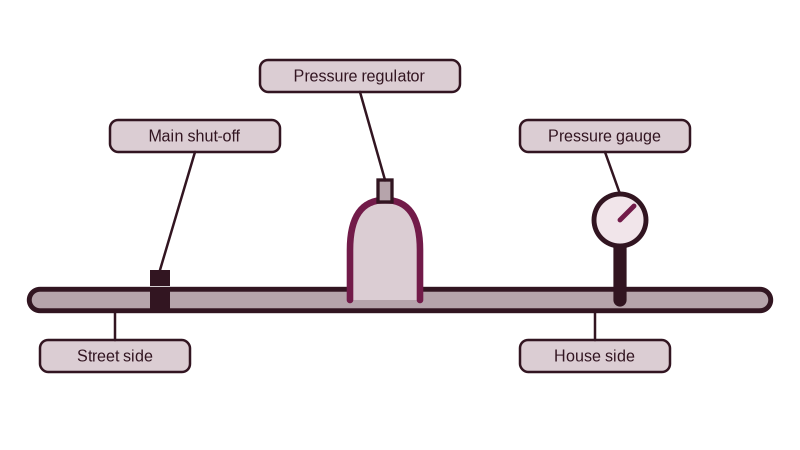
A plumber who says a house needs a three-quarter inch regulator is naming the size of the pipe it threads or solders onto, not a pressure. Most single-family homes draw water through a line sized at three-quarter inch or one inch, and the regulator is a bell-shaped brass valve placed right after the main shut-off. This page sits alongside the wider guide to water pressure and valves from Conejo Plumbing Pros. It covers the regulator's job, how to test it, and how replacement goes.
What does a 3/4 inch pressure regulator do?
It brings the incoming supply down to a steady, lower pressure for the whole house. Within the body, a spring and diaphragm work a valve to hold the set pressure, even as street pressure shifts. The 3/4 inch figure is the pipe connection size, which has to match your main line.
With no regulator, houses on a high-pressure street or in a low area receive full supply pressure, straining supply lines, toilet valves, washing machine hoses, water heaters and faucet cartridges. Hillside neighborhoods span big elevation differences, so street pressure tends to be highest down at the bottom of a hill.
Most regulators have an adjusting screw and a lock nut on top. Many are set at the factory or by the installer to a value near the middle of the range that fixtures are designed for. Check your fixtures' paperwork if you want a specific number.
How can you measure your water pressure?
Screw an inexpensive hardware-store pressure gauge onto the washing machine connection or an outdoor hose bib. Stop all water use in the house, open the tap and note the needle. That reading is the static pressure. A very high reading, or one that swings widely through the day, means the regulator needs attention.
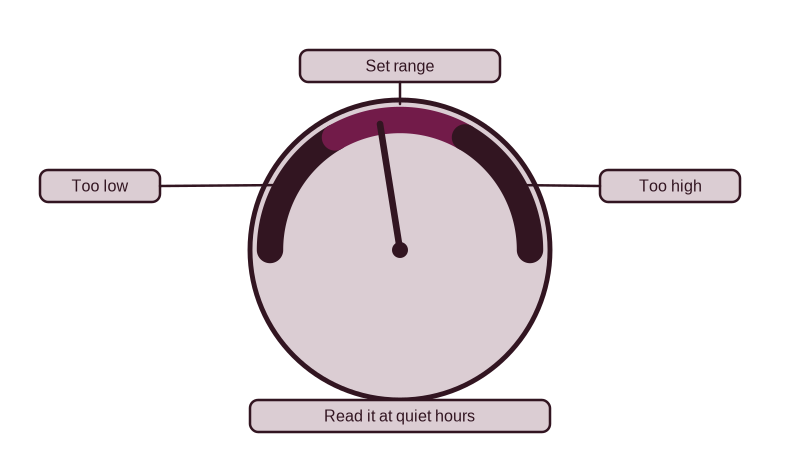
Test at different times, since pressure moves through the day. Peaks tend to come late at night and in the small hours, when demand is low. Some gauges carry a second needle that records the maximum, which is useful.
Then read the pressure while a fixture runs. A large drop suggests a clogged strainer, a partly shut valve or a regulator that cannot keep up. High gauge readings together with noisy pipes or leaking fixtures show the regulator is not holding. See what a regulator looks like for how to find it.
How do I know the regulator is failing?
Watch for pressure that runs too high or too low, readings that rise overnight, banging pipes, a relief valve dripping on the water heater, toilets that run on, hoses that burst or leak, and fixtures wearing out early. Failure tends to be gradual, so the symptoms creep in over months.
A diaphragm that has torn lets full street pressure through, whereas grit can clog one and choke the flow. Pressure that creeps up overnight with no water in use points to a regulator not shutting off fully, or to thermal expansion in the water heater.
Hard water deposits scale and grit inside the valve. Sediment in the supply, for example after street work, can foul the seat. Some models have a replaceable strainer, and cleaning it may help. For wider causes of poor flow, read about what causes low pressure.
Can you adjust the regulator on your own safely?
In most cases, yes. Loosen the lock nut, then turn the adjusting screw clockwise for more pressure or counterclockwise for less, with a gauge attached to watch the result. Make small turns, let the reading settle, then tighten the lock nut. If the pressure does not respond, the regulator needs replacing.
Be patient, since a regulator may take several seconds to settle after each adjustment. Run a tap briefly to stabilize the pressure, shut it, and read the gauge again. Never set it above what your fixtures can handle. Many household fixtures are built for moderate pressure, and the top of the range is not a goal.
A regulator that cannot hold a setting, or does nothing after being turned all the way, is worn out. Adjustment will not fix that.
What does replacing a 3/4 inch regulator involve?
Replacement runs like this: the plumber shuts the water at the main and drains the line, then cuts out or unscrews the old regulator, fits the new one facing the same flow direction, and tests for leaks and pressure. A straight swap is usually quick work. Changing the pipe layout, adding unions or relocating the valve adds time.
Direction of flow is marked on the body with an arrow. Installing it backward stops the water or makes it behave oddly. Many plumbers add unions on either side, which makes the next replacement easy, and a pressure gauge port so you can check the pressure without a hose bib.
If the house has a water heater with a closed system, a thermal expansion tank is often added or checked at the same time, since the regulator can trap pressure. Needing an expansion tank depends on the setup, and the plumber can say once the system is checked. For an aging heater, see the cost of a water heater replacement.
Does swapping a regulator need a permit?
That turns on the office and the scope. A matching regulator swap is often handled as a minor repair, but changes to the main line or meter connection may require a permit. Ask City of Thousand Oaks Building and Safety, the City of Westlake Village or the Ventura County Resource Management Agency, depending on your address.
Water meters and the street side of the shut-off belong to the water supplier, not to you. Do not touch the meter or the valve at the meter. Your side starts at your own shut-off. If there is a problem on the supplier's side, such as a pressure that is too high at the street, ask the supplier.
For homes on private wells, as in parts of Hidden Valley, the pressure comes from a pump and pressure tank, and the pressure switch sets the range. A regulator may still be used, but the supply is different from a city main.
At what point should a plumber take over?
Bring in a plumber if the main shut-off refuses to close, the regulator is soldered in and needs a torch, the pipe is galvanized and fragile, a water softener or backflow device sits nearby, or the pressure readings confuse you. A seized shut-off valve can turn regulator replacement into a bigger job.
A plumber can also check for thermal expansion, test the heater's relief valve and look for other damage from high pressure. Pressure that stayed too high for years can leave leaks and worn fixtures behind. See burst pipe prevention for other checks.
Describe the symptom and any gauge reading in the quote form. We pass requests to local plumbing businesses, which pay a fee to receive them, and we read them on weekdays between 9am and 5pm.
Common questions
Which pressure range suits a home?
Many fixtures are built for moderate household pressure, and the maker's paperwork gives the range for yours. A gauge reading near the middle of that range is the usual aim. If your reading is very high, a regulator can lower it, and a plumber can advise what suits your home.
How long does a pressure regulator last?
Service life depends on brand, water quality and street pressure, and grit and heavy demand shorten it. Since failure is gradual, test pressure with a gauge once a year. If it keeps climbing or leaks appear, replace the regulator promptly, before it does damage.
Is a 3/4 inch regulator right for my house?
It is common, though not universal. Measure the pipe at the main shut-off, where the size is often stamped or found by measuring around the outside. A plumber matches the regulator to the pipe and the flow required. An undersized regulator can restrict flow in a larger house.
Do I need to be home for the regulator replacement?
Yes, someone has to be there to show the plumber the main shut-off and the regulator, and to hear the findings. The water goes off for a short time, so allow for that. Mention pets, and clear space around the regulator, which often sits in a garage or crawl space.