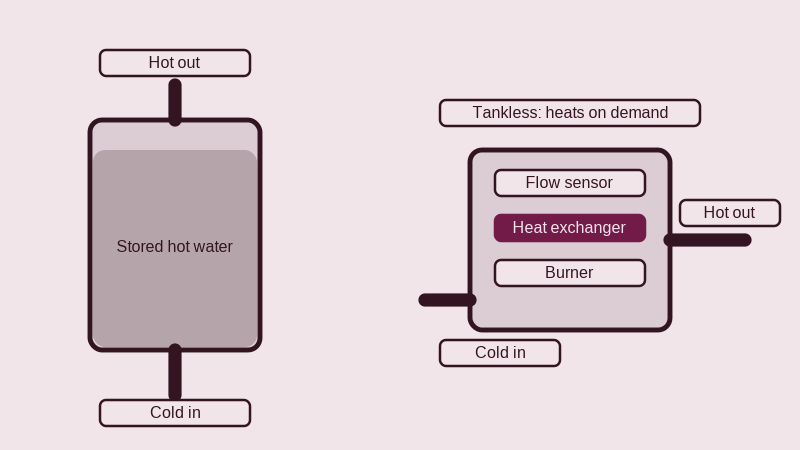
A tank water heater costs less to buy and swap, and it handles several taps at once until the tank runs cold. A tankless water heater costs more up front, never runs out as long as demand stays inside its rating, and takes less wall space. Most Conejo Valley households do well with either, so the decision comes down to household size, fuel and the existing gas line. It belongs to the wider water heater service overview, and once you know your preference you can request a price.
Which type is the better pick for a family home?
For most families the straight answer turns on how much hot water is drawn simultaneously. A tank fits if you want to spend less at purchase and keep a later replacement simple. Choose tankless if cold showers after the tank empties annoy you, if you could use the wall space, or if your gas line is already big enough. Neither type is wrong for the area.
A tank is an insulated cylinder that keeps forty or fifty gallons or so hot around the clock. When you open a tap, hot water leaves the top and cold water refills the bottom. The cost of that design is standby loss, because heat slowly escapes even while everyone is asleep or away for the weekend.
A tankless unit has no reservoir. A flow sensor notices a tap opening, a burner or heating element fires, and a heat exchanger warms the water as it passes through. The limit is not volume but flow: the unit can only raise so many gallons per minute by a given temperature. Run the dishwasher, two showers and a washing machine together and a small unit will give you lukewarm water.
What do the benefits of tankless look like in practice?
The main benefit is a steady supply: a tankless unit keeps going for as long as you stay within its rated flow. Other benefits are a smaller footprint on the garage or closet wall, no stored water to leak, and no standby heat loss. Against that, the unit needs correct venting, a suitable gas supply or electrical service, and periodic descaling.
People often ask whether tankless saves energy. It usually uses less fuel for the same hot water because it skips standby loss, and the gap is biggest in a small household that draws hot water in brief bursts. In a large household that draws hot water almost constantly, the saving shrinks. No percentage is given on this page, since results swing with the model and your habits.
Tankless units also tend to last longer than tanks when they are descaled on schedule, and parts can often be replaced rather than the whole unit. A tank, by contrast, usually fails at the shell, and a leaking shell cannot be repaired. The signs of age are listed in our guide to the lifespan of a water heater.
Can I size a heater myself with a simple calculator method?
Start from peak demand: total the flow rating of every fixture that could be running together, then set that against what the unit can deliver at your temperature rise. The temperature rise is your target temperature minus the temperature of the water entering the house. A plumber will check this on site. You can do the rough version at the kitchen table.
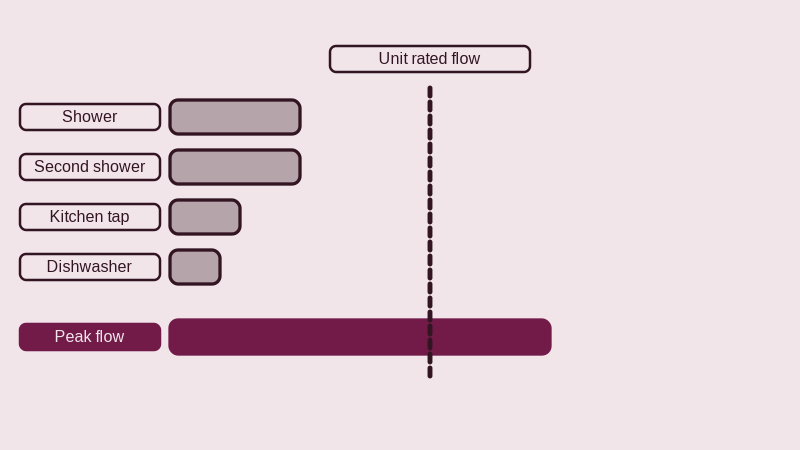
Here is the method in four steps:
- List the fixtures that realistically run together on a busy morning, such as two showers and a kitchen tap.
- Find each fixture's gallons per minute. Newer showerheads and faucets have the figure printed on the fixture or in the box.
- Add the numbers to get your peak flow.
- Hold that total against the maker's flow rating at the rise you need. Colder winter inlet water lowers what a unit can deliver.
When peak flow exceeds what one unit handles, your options are a larger model, two units or keeping a tank. If you keep a tank, look at the yellow label and use its first-hour rating, not just the gallon capacity.
Is tankless gas or electric better, and what about propane?
Gas tankless units move far more heat than electric ones, so they are the usual choice in a whole house. Electric tankless heaters can need very heavy electrical service that many older panels cannot supply without an upgrade. Propane units work like gas ones but need a conversion or a propane-rated model, plus a tank and supplier. Check which fuel your street actually has.
Where gas service reaches your street, SoCalGas is the utility that provides it. Have the plumber confirm that the current line is large enough: tankless gas units pull a heavy volume at once, and older houses can need a bigger line before the unit performs. Rules apply to gas piping, and our gas line cost guide covers them.
Electric tank heaters are simple and common where there is no gas. Electric tankless suits a small apartment-sized load, a bathroom or a guest suite, more than a four-bedroom house. If you are in a larger estate property around Lake Sherwood or Hidden Valley, confirm what fuel is available before you pick a model, since fuel availability varies by property.
Is a mini tank the same thing as tankless?
No. Holding only two to a few gallons, a mini tank is a small storage heater placed next to one sink or bathroom so a faraway tap gets hot water sooner. It cannot stand in for a house water heater. People confuse it with tankless because it is small and mounts under a counter, but it stores water and cannot supply a shower for long.
A mini tank suits a lone vanity far down the pipe from the main heater. It cuts the delay for hot water at that sink, and in many cases it plugs into an ordinary outlet. Long showers are beyond it.
How do tank and tankless compare on cost over time?
A tank heater is cheaper to buy and to install. A tankless unit carries a higher purchase price, at times with added work on venting, gas line size or electrical capacity, and may cost less to run. Payback depends on how long you stay, fuel prices and how often the unit is descaled. No dollar figures appear on this page, as there is no source to cite for them. The real numbers come from a written quote by a local plumber.
Request two quotes for the same house, one for a tank replaced in kind and one for tankless, with the extras itemized apart: venting, gas line change, electrical, condensate drain, permit and haul-away. Compare the extras line by line. If you want a deeper breakdown, read our guides to tankless installation cost and tank replacement cost.
If you read a comparison online, check its date and whether it matches your fuel and model. Details differ by maker and by house.
When is replacement smarter than repair, and what if a tankless unit breaks?
Replace a tank once the shell leaks, the base rusts or its normal lifespan is over. A tankless unit is worth repairing when a sensor, igniter, fan or scale blockage is at fault, as those parts can be swapped. Which situation applies to you is something a plumber can tell after looking over the unit.
A tank nearing its end shows puddles at the base, hot water the color of rust, popping or rumbling from sediment, and an age well beyond the norm. A tankless unit that needs attention shows error codes on the display, lukewarm output or water that cycles between hot and cold. Scale from imported water is a common cause of poor performance, so ask about a flush. Our anode rod guide explains one cheap way to extend a tank's life.
Does a water softener change the answer?
Yes. A softener lowers scale, which protects a tankless heat exchanger and slows sediment in a tank. If you already have a softener, a tankless unit becomes easier to keep healthy. If you have noticeably hard water and no softener, plan on regular descaling. Our hard water scale prevention page covers the options.
What does installation involve in a Conejo Valley home?
In California, replacing a heater usually calls for a permit and an inspection, and the unit has to be braced against earthquakes. Inside city limits, the City of Thousand Oaks Building and Safety issues the permit. Unincorporated areas fall under the Ventura County Resource Management Agency. The plumber typically obtains the permit, and you should ask who will.
In tract homes dating from the 1960s to the 1990s, the heater is often in the garage, vented up through the roof. A switch to tankless means a new vent path, sometimes through a wall, and possibly a new condensate drain. Newer homes in Dos Vientos and North Ranch may already have space and gas capacity set up. Ask each bidder what they will do with the old flue.
If gas is your fuel, the gas tankless versus tank comparison goes through the gas-specific points.
Common questions
How much time does converting from tank to tankless take?
A like-for-like tank replacement is often done in half a day. Conversion to tankless takes longer because of new venting, gas piping or electrical work, and a day or more is common. The plumber can give a time estimate once the garage or closet has been seen. Water is off for part of the job, so plan on no hot water that day.
What should I check before accepting a quote?
Establish what the price covers: permit, venting, gas line changes, expansion tank, haul-away and a condensate drain. Also confirm who pulls the permit, who does the work, and that the contractor has a California contractor license. Insist that the written quote names the unit model. If anything is listed as an allowance, ask what happens when the actual cost differs.
Will a tankless heater work if my gas line is small?
Possibly not. Tankless gas units need more gas at once than most tanks, so a small or long gas line can starve the burner and cause error codes. A plumber measures the line, counts the other gas appliances on it and tells you whether it needs upsizing. Only a contractor may do gas work, so leave that part alone.
Can I repair a tankless water heater myself?
Descaling and cleaning an inlet filter are fine if the manual permits, but internal repairs, gas connections and venting belong to a professional. Many warranties assume a qualified installer. Should you smell gas, get out of the building and contact SoCalGas at 1-800-427-2200 from outside, or 911 when anyone is in danger. Our water heater service page explains how repair requests work.
Is a propane tankless heater a good choice for a rural lot?
It can be, where no natural gas line exists. Propane units need a propane tank, a regulator, and a supplier, plus a model rated for propane. Operating cost depends on propane prices, which change often. Ask for quotes for both propane and electric options so you can compare over several years, and confirm local rules on tank placement before choosing.
Return to Conejo Plumbing Pros for every service and area on the site.