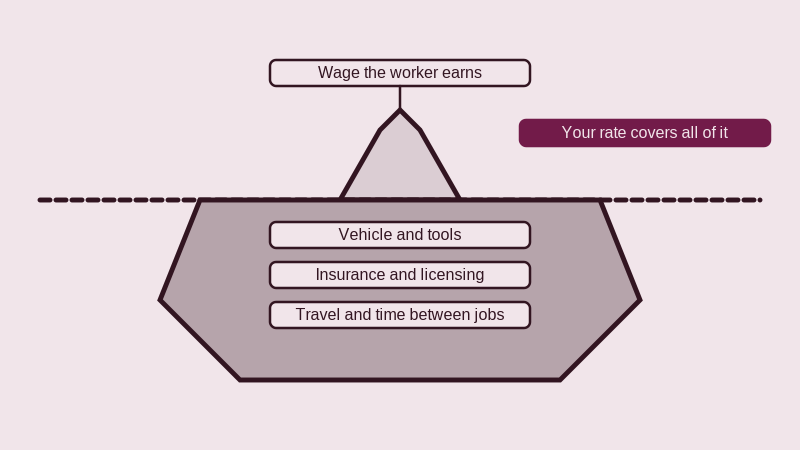
No single hourly rate is right for a plumber in Thousand Oaks, and an invented figure would mislead you. We can show how a rate is built and where a bill really comes from. According to Bureau of Labor Statistics data, the national median wage for plumbers, pipefitters and steamfitters was $30.67 per hour in May 2025; that is what a worker earns, not what a customer pays. A customer's rate also has to cover the van, tools, insurance, parts handling and the time between jobs. For a real price on your job, use the quote form at Conejo Plumbing Pros and a local plumber quotes it in writing.
What makes up a plumber's hourly rate?
A plumber's rate covers more than the person's wage: a vehicle and fuel, tools and test equipment, insurance, office costs, licensing, travel time and the stretches between jobs. That is why a customer's hourly price sits well above the pay figure the Bureau of Labor Statistics publishes. The rate also moves with the type of job and the hour it is done.
Emergency or after-hours visits are priced differently from routine daytime work. A plumber who keeps a van stocked with common parts costs more per hour than one who has to fetch parts, but may finish faster. A second person on the job, a camera or a specialist tool changes the figure again.
Rates should be stated before you agree. If a plumber will not tell you how time is charged, whether travel is included and what the minimum is, treat that as a reason to compare another quote.
Hourly or flat price: which is better?
When the job is clearly defined, a fixed price is simpler to compare and shields you from surprises. Hourly pricing suits open-ended diagnostic work, such as hunting for a leak. Many plumbers do both: an hourly diagnostic, then a fixed price for the repair once they know what it is. Ask which model applies before the work starts.
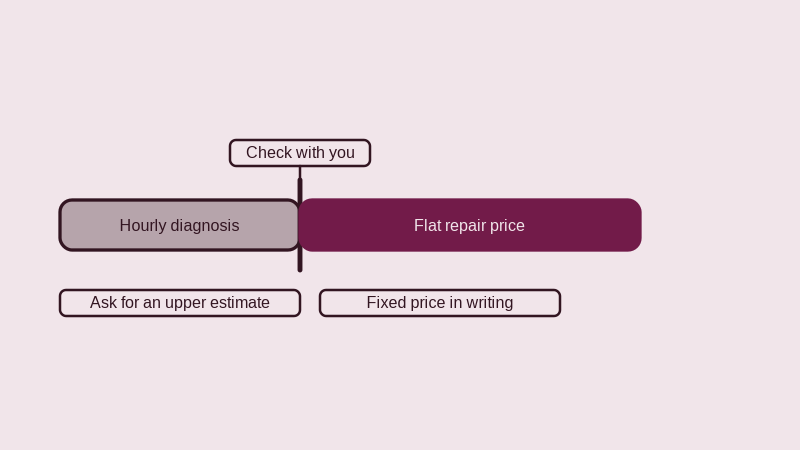
A flat price works when the scope is clear: replacing a toilet, a faucet or a water heater. An hourly rate works when the scope is uncertain. With hourly work, ask for an upper estimate and a point at which the plumber stops and checks with you.
The real question is clarity, not price. Line quotes up against the same scope. For a sense of how pricing differs across common jobs, see our guides on plumber cost, faucet replacement cost and water heater replacement cost.
What is a call-out fee, and do I always pay it?
A call-out fee (sometimes labeled a service call or trip charge) covers the cost of sending a plumber to your door and assessing the problem. It might be a flat amount, might include the first stretch of work, or might be credited against the repair should you go ahead. Check which applies before you book.
Some plumbers waive it when you accept the repair; others do not. A quote that lists the call-out fee, the hourly rate once the first period is over, and the parts separately is clearer than one lump number. If a plumber says the visit comes free of any call-out charge, ask what the minimum charge is, since a minimum can work the same way.
We arrange the visit; the plumber sets the fee, and the price is confirmed before work starts. The form is checked on weekdays between 9am and 5pm, and there is no round-the-clock dispatch.
What do jobs like an outdoor spigot or a burst pipe cost?
Small jobs like replacing an outdoor spigot are mostly the call-out, a short stretch of labor and a few parts. Larger jobs such as a burst pipe depend on access, damage and finishes, and cost far more because opening and closing walls takes time. Neither has a sourced figure here, so quotes are the way to find the price.
For an outdoor faucet the difference between fixing and replacing matters. A dripping hose bib may need only a washer or a packing nut, and what you can do yourself is explained in fixing a leaky outdoor faucet and leaky exterior faucet. A frost-free spigot that leaks within the wall calls for a plumber.
For leaks and breaks, read slab leak repair cost. As for what a leak wastes, the EPA estimates that a typical household loses more than 9,300 gallons of water a year to leaks.
Can plumbing cost be estimated per square foot?
Plumbing prices for new construction are sometimes discussed per square foot, but for repairs it is not a useful measure. A repair depends on the fixtures, the pipe, access and the problem rather than on how big the house is. For a whole-house repipe, size matters as a rough proxy for pipe length, but the number of fixtures and the wall access matter more.
Online plumbing cost estimators and calculators can give a starting point, but they are only as good as the inputs and they cannot see your walls. For a full replacement of water lines in an older home, have the plumber price it after a walk-through, not from the floor area. What drives that figure is laid out in our repiping cost guide.
New homes in Dos Vientos and North Ranch can have plumbing that is easier to reach than older homes in Casa Conejo and Wildwood, which can change the labor hours for the same job.
How do I judge whether a plumbing quote is fair?
A fair quote lists the scope, the parts, the labor basis, any call-out fee and any permit costs, and it names what is not included. Gather two or more quotes for an identical scope of work, find out what happens if a second problem turns up, and be wary of a figure well below the rest with no explanation.
Look for these in writing:
- What exactly is being done, and which parts are included.
- How labor is charged: flat, hourly, or a minimum plus hourly.
- Whether a permit is needed, who pulls it and who pays.
- How a bigger-than-expected job would be handled.
- Payment terms and any deposit. Check the California Contractors State License Board guidance before agreeing to a deposit.
Ask for the contractor's license number and look it up on the CSLB site. A quote that is vague about what is included is a reason to ask more, not to sign.
Common questions
What hourly rate applies to emergency plumbing?
Emergency and after-hours work typically costs more per hour than routine daytime work, though no sourced figure for Thousand Oaks is available to us. Before work begins, ask about the call-out fee, any minimum charge and the emergency rate itself. Get the numbers in writing if you can.
Do plumbers charge for travel time?
Some do, using a call-out or trip fee, while others fold it into the hourly rate. Ask which. A quote that separates travel, labor and parts is easiest to compare. If the plumber has to return for parts, ask whether the second trip is charged.
Is the BLS hourly wage what customers pay?
No. In May 2025 the national median wage in this trade, covering plumbers, pipefitters and steamfitters, was $30.67 per hour, which is what the worker earns. A customer's rate includes the business's costs of vehicles, tools, insurance and time between jobs, so it is a good deal higher.
Is it cheaper to supply the fixture myself?
Sometimes, but check first. Some plumbers will not warrant a part they did not supply, and the wrong fixture can cost a second visit. Ask the plumber whether they will install a fixture you bought, and what size and model they need. See faucet install cost.