An outdoor faucet, known as a hose bib or sillcock, is the most neglected fixture on a house. It sits in the sun, gets a hose pulled sideways, and rarely draws a glance until it drips. This page belongs to our help with faucets, sinks, showers and disposals from Conejo Plumbing Pros. The remedy depends on where the water appears, so first watch the faucet closely with the hose off and then with the water running.
Which part of the faucet is leaking?
Inspect three places: the spout while the faucet is closed, the stem behind the handle while it is open, and the wall or pipe behind and below. Each implicates a different part with a different repair, so check before buying parts.
If the spout drips while the handle is shut, the washer or seat inside is worn. Water squirting around the handle as you turn it on means the packing nut or packing is loose or worn. Water on the wall, in a garage, in a crawl space or on the ceiling below means the leak is in the pipe or in the faucet body inside the wall.
Clear the hose, splitter and nozzle first, since a leak at the hose connection is sometimes just a worn rubber washer in the hose coupling. Replace that and test before assuming the faucet is at fault.
What cures a drip at the spout?
Turn off the water, unscrew the packing nut and slide out the stem. Swap the rubber washer at the end, held by a small screw, and examine the seat inside the faucet for pitting. Reassemble, restore the water and test. A fresh washer cures most spout drips.
Take the old washer along to the hardware store to find an exact match, as sizes and shapes vary. A seat dressing tool can smooth a rough seat, and a replacement stem or whole faucet is the alternative. A worn seat chews through a new washer quickly.
A quarter-turn ball valve version has no washer, so the fix is replacing the valve. These are common on newer homes. When the faucet is old, rusted at the base or short of available parts, installing a new one is usually simpler. Our note on what a faucet installation costs shows how the job is priced.
How can a leak around the handle be stopped?
Shut the faucet, loosen the handle screw, lift off the handle and find the packing nut underneath. Give it a quarter turn with a wrench, open the faucet, and see if the leak stops. If not, take out the nut and replace the packing washer, or wind fresh packing string around the stem.
This is the commonest outdoor faucet repair and one of the easiest. Do not overtighten, since the handle must still turn freely. A corroded stem, or packing that will not seat, makes replacing the whole stem the better choice, and it costs little.
Water off first. Many outdoor faucets lack their own shut-off, so close the main valve or the interior stop valve serving the faucet, often under a sink, in a garage or in a crawl space. Cannot find it? Shut the main and let the faucet run empty.
When does replacing the faucet beat repairing it?
Go for a new faucet when the body is cracked or corroded, the stem is stripped, the threads are damaged, parts cannot be found or the leak is hidden in the wall. A new faucet costs little next to repeated repairs, and it is a good moment to fit a frost-free or quarter-turn model.
Replacement means cutting the old faucet off the supply and joining the new one, which depends on whether the pipe is copper, PEX or another material. Threaded and soldered connections need different tools. A copper joint needs a torch and some skill, while a push-fit connector is easier but costs more.
If pipework makes you uneasy, or the pipe is inside the wall, ask a plumber. Leaks at the wall plate, behind siding or in stucco need care so the wall does not take on water. That is a good reason to ask for help rather than improvise.
When is it time to bring in a plumber?
Ask for help if water is escaping within the wall, the pipe is galvanized and the old faucet will not turn, you cannot find a shut-off valve, a repair fails to last or the wall is wet. Outdoor lines in stucco and tile can hide a lot, and a plumber has the gear to trace them.
Water on the ground is only half the story. Check whether the leak ties to a bigger issue such as high water pressure, and look at the meter. Our page about water pressure explains how a regulator can be involved.
When you are ready, describe the faucet and the symptom on the quote form, and local plumbing businesses can come back with a price.
For a hose bib dripping at the spout or the handle, the steps in fixing a leaky faucet outside cover the same repair from another angle.
Why does the vacuum breaker on the spout matter?
Many outdoor faucets carry a small cap-shaped device on the spout, a vacuum breaker that stops dirty water running back into the house supply. A slight weep when the faucet is switched on or off is normal. If it keeps dripping or spraying, it is worn and the faucet needs a new one.
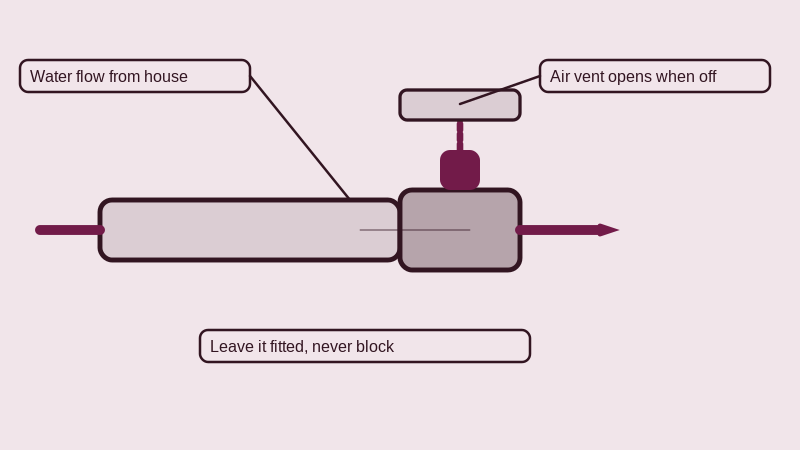
Do not remove or block the vacuum breaker. It protects your drinking water, and where a water supplier or building office has rules about backflow, it is part of staying within them. A small repair kit replaces the working parts on many models.
If a garden hose is left connected, water trapped in it can push back against the breaker. Disconnect hoses when not in use, and especially before cold nights. A hose with a sprayer left attached keeps pressure on the fitting and shortens its life.
How do you know whether the leak is inside the wall?
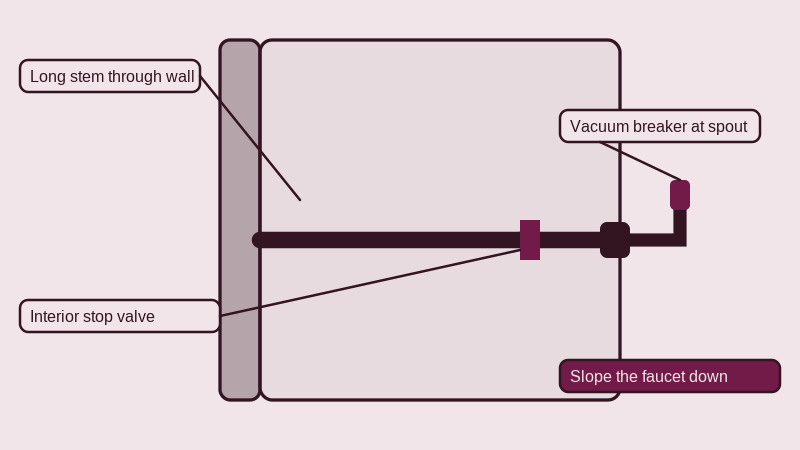
Look for a damp or stained wall by the faucet, water in the crawl space or garage beneath, a hose bib dripping even when fully closed, mold or musty smells, and a meter moving with everything off. Many leaks start in the long stem of a frost-free faucet, at the point where it goes through the wall.
A frost-free sillcock has a long stem so the shut-off point sits inside the heated part of the house. If the hose was left on in cold weather, water may have frozen and cracked the barrel. The faucet seems fine until the water is turned on, then it leaks inside the wall. Slope the faucet slightly downward on installation so it drains.
If you suspect an inside leak, close the supply at the interior stop, if there is one, and ask for a plumber. To confirm a hidden leak at the meter, read a big water bill but no leak in sight.
Common questions
Why does my outdoor faucet drip only with the hose on?
Usually the packing around the stem is worn or loose, so water escapes when the faucet is open and pressurized. Tighten the packing nut gently, and if that fails, replace the packing or the stem. A drip at the hose end instead points to a worn coupling washer.
Can an outdoor faucet be repaired with the water on?
Not safely. With the supply still on, water pushes out as soon as you open the faucet. Find the interior stop valve or close the main. If neither works, or the stop valve will not close, that in itself is a reason to ask for a plumber.
How do I protect an outdoor faucet from cold nights?
Disconnect the hose, drain the line, and fit an insulated cover. A frost-free faucet needs the hose off so it can drain, and it should slope slightly downward. Hard freezes are not the norm in the Conejo Valley, so it is mainly worth doing when a cold snap is forecast.
Does someone need to be home during the repair?
An adult should be there to show the faucet, the leak and the shut-off valve, and to approve changes. If the job requires entry to a garage or crawl space, that person should unlock it. Mention any pets to the plumber, and keep the area around the faucet clear.