A tank water heater usually needs replacing at roughly ten years. Some fail sooner, especially where scale builds fast, and a well-kept unit can run longer. A tankless unit commonly outlasts a tank when it is descaled on schedule. Read on for the checks that show when yours is due, and visit the main water heater page for repairs. Whenever you want a quote, ask for a price.
How long does a tank water heater really last?
Public guidance, such as the City of Portland's water heater page, puts a tank-style heater at about ten years, and ENERGY STAR cites about 20 years for tankless, though real life varies widely. Life is shortened by hard water, a worn anode rod and skipped flushing, and lengthened by a steady schedule of checks. The data plate gives the age, because the serial number encodes the month and year of manufacture.
Find the age first. Read the label on the side of the tank. Many manufacturers encode the date in the serial number, using a letter for the month and digits for the year. If it is unreadable, the brand's support line can decode the number for you.
Age is a guide, not a verdict. A seven-year-old heater that leaks from the shell is finished. A twelve-year-old heater with clean water, no rust and a good relief valve may be fine for a little longer. Treat the decision as a risk call: when a tank does fail it can release the whole tank volume across a garage or closet floor.
When is a tank water heater past saving?
It is past saving when water seeps from the shell or bottom, because corrosion has holed the steel and nothing can seal it. Other signals are a rusty tint in hot water, a heater that rumbles or pops loudly, and repeated repairs. Leaks at fittings on top are different, and a plumber can often repair those.
Check these things once a season:
- Dry floor and no stain under the tank
- Water that runs clear rather than rust brown
- No white or green crust at the connections
- The relief valve lever moves freely and the discharge pipe is dry
- No new rumbling when the burner fires
If the only problem is the relief valve or an element, read our pages on replacing a relief valve and replacing an element before assuming the whole unit has to go.
What is the right interval for anode rod checks?
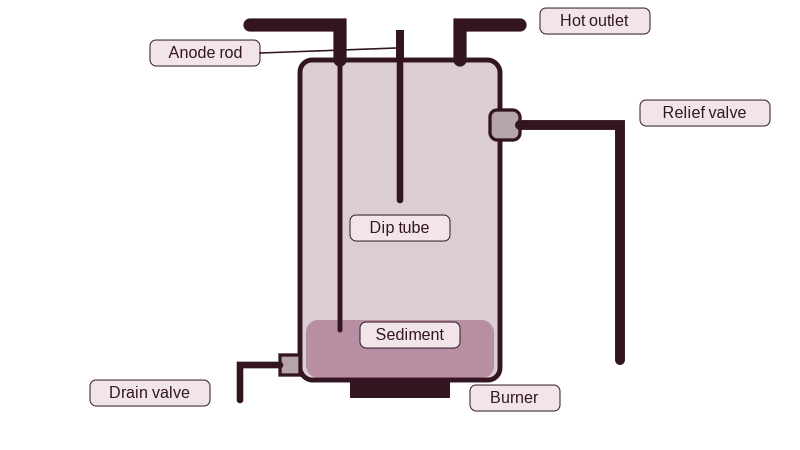
Get the anode rod inspected every few years, and replace it when most of the metal has gone. The rod corrodes deliberately to shield the tank steel. Harder water, or water with more dissolved minerals, uses it up faster. A worn rod is the cheapest way to add years to a heater, so inspect before the warranty period ends.
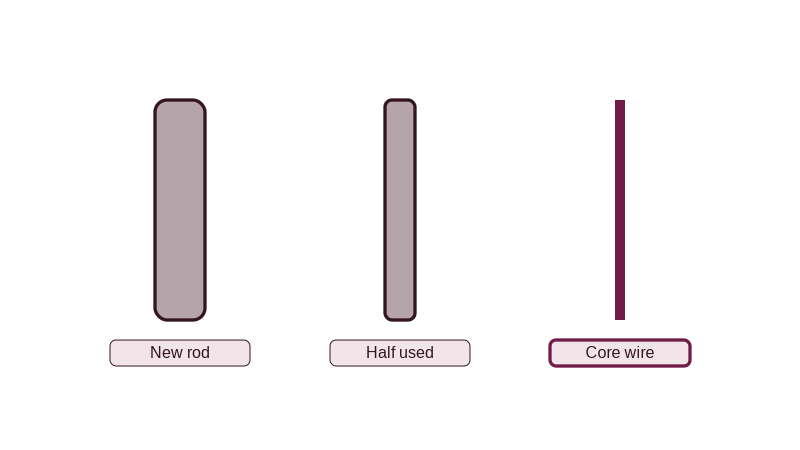
You need a socket, room above the tank to pull the rod, and a willingness to do a bit of work. Some heaters have little headroom, and a segmented rod bends in. If the rod is down to a thin core wire, replace it. If the tank has already started to leak, the rod can no longer save it. Details are on our anode rod page.
How frequently should a tank heater be flushed?
Flush a tank roughly yearly, more often with hard water. Flushing clears sediment from the bottom, where it blankets the burner or element, blocks heat from reaching the water and makes the unit noisy and slower. Attach a hose to the drain valve, run it to a safe spot, let the water flow until it clears, then refill so the tank is full before relighting or powering on.
Keep the safety steps in mind: turn the gas control or the breaker off first, let the water cool, open a hot tap upstairs so air can enter, and close the drain before refilling. A plastic drain valve clogged with sediment, or one that will not close afterward, is the point to stop and hire a plumber instead of forcing it.
Do tankless water heaters need maintenance?
Yes. Tankless units want a descaling flush on a regular schedule, a clean inlet filter, and an occasional look at the vent and condensate drain on high-efficiency models. Skipping this brings error codes and weaker heating. The manual states the intervals, and hard water shortens them.
The usual process uses a small pump, two hoses and a bucket of white vinegar or a manufacturer-approved descaling product, circulated through the heat exchanger for a set time. Many owners hire a plumber, since it involves isolation valves and some care to restore flow. Units installed without service valves cost more to flush, so request them at installation.
How often should a tankless unit with a softener be flushed?
Less often than without one, since a functioning softener takes out the bulk of the scale that clogs the heat exchanger. Many owners still flush yearly, since softeners can fail or run out of salt unnoticed. Look up the base interval in the manufacturer's manual, then test water hardness downstream of the softener to decide whether to stretch it.
If your softener has been off for a month, the scale clock has restarted. A simple test strip on the hot tap tells you more than a calendar. Our guides to preventing hard water scale and installing a softener cover the water side of the question.
Is it better to replace on a schedule or wait for failure?
Replacing before it fails costs less in damage and stress, and you choose the time and the model. Waiting means a cold-shower emergency, a rushed purchase and possible water damage. If the tank is ten years old or more, plan the replacement and get quotes now. If it is younger and healthy, keep up the maintenance.
Local factors matter. Many Thousand Oaks and Newbury Park homes date from the 1960s onward, so a good number of original heaters have likely been replaced already, and the unit in the garage may be the second or third generation. Newer homes in Dos Vientos, approved in 1988, may still have a first heater.
For a swap in California, the plumber typically takes care of the permit and bracing. The relevant office is City of Thousand Oaks Building and Safety for city addresses. For homes in unincorporated areas such as Lake Sherwood and Hidden Valley, it is the Ventura County Resource Management Agency. Ask who pulls the permit. Our tank vs tankless comparison helps decide what to put in next.
How do you budget for a replacement?
Plan your budget by requesting written quotes that itemize the unit, venting, permit, expansion tank, new shutoff valves and haul-away. No dollar figures appear here, because none come from a source we can name. Our page on the cost drivers of water heater replacement helps, and get at least two quotes to compare.
Common questions
Does a water heater warranty cover the whole unit for its stated length?
Often a warranty protects the tank against leaks for several years, with shorter cover for parts and little or none for labor. Read the paperwork for exclusions, such as damage from poor installation or skipped maintenance. Keep the receipt and a photo of the serial number. A plumber can say what is likely to be covered before you file a claim.
Can I stretch the life of a heater that is nearly ten years old?
Flushing, checking the anode rod and testing the relief valve can slow the decline, but corrosion that has already eaten the tank wall cannot be reversed. If the heater is still dry and the rod is worn, a new rod is cheap insurance. Rust at the base, or dampness, means planning a replacement.
What does a plumber check when asked about replacement timing?
A plumber examines the age plate, water quality, the anode rod where reachable, sediment noise, rust or moisture at the base, the relief valve, venting and strapping. Then comes a verdict: service it or replace it. Ask for the findings in writing so you can set them beside a second opinion.
Should I replace a gas heater with another tank or go tankless?
Either works. A tank is cheaper to install and replace. Tankless saves floor space and runs on demand, but may need gas line, venting or electrical changes. Check which fits your household and your meter. Our gas tankless guide explains what that upgrade involves.
Who do I contact to arrange a plumber?
Fill in the quote form on the price request page, giving the heater's age, the fuel and what you have noticed. A local plumber then visits with a written quote. You can also begin at Conejo Plumbing Pros and browse the other pages first.