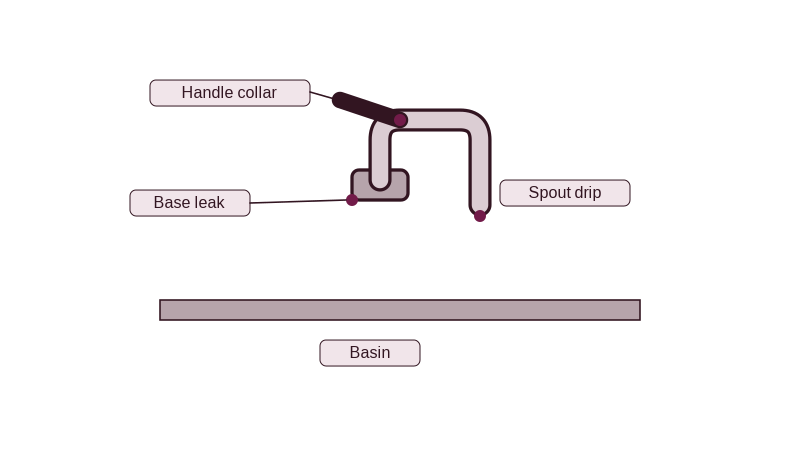
Dripping from the spout means a worn seat, washer or cartridge, whereas seepage near the handle or base means a tired O-ring or a slack packing nut. Shut the two small valves under the basin, take the faucet apart in the order shown below, install a matching part and reassemble. Allow about an hour, with a screwdriver and an adjustable wrench. Prefer not to? Conejo Plumbing Pros can hand your quote form to a local plumbing business. Related fixture work is covered by our garbage disposal and fixture repair page.
Where is my bathroom faucet leaking from?
Note exactly where the moisture appears. If the spout drips while the faucet is shut, expect a worn cartridge, seat or washer. A puddle around the base or the handle's collar hints at the packing nut or an O-ring. A damp cabinet floor may come from a supply line or drain connection instead of the faucet. Dry everything and watch.
Wipe the faucet and basin dry, then tuck a dry paper towel beneath the spout and another around the base. Give it fifteen minutes. Whichever towel is damp reveals the failing part. A wet underside with a dry top calls for a look at the braided supply hoses and the drain's slip nut. That route is covered in our guide to a leak beneath the basin.
Run the faucet and check the water coming through the spout. A faucet that sputters or sprays sideways, rather than drips, often has a mineral-clogged aerator. Unscrew the tip, soak it in vinegar and brush the screen clean.
What tools and parts do I need?
Collect an adjustable wrench, screwdrivers, hex keys, a flashlight and a rag. You also need spare parts that fit your faucet: washers and seats for compression types, or a cartridge, ball or O-rings for the rest. Take the worn part along to the shop and compare it directly. Plumber's grease and a small bowl for screws are handy extras.
Check the brand name on the faucet body or the underside of the handle. Many manufacturers list parts by model. If you cannot find a name, the old cartridge or washer is the best template. Photograph each step during disassembly so reassembly is straightforward.
Close the sink drain with a cloth or a plug so a dropped screw or small part does not vanish. An aged, corroded faucet may have parts that are no longer sold, and then it is time to weigh replacing the faucet rather than repairing it.
How do I fix a two-handle bathroom faucet?
Shut both stop valves under the basin, then drain the faucet by opening it. Pry the decorative cap off the handle, remove the screw beneath it and lift the handle away. Back out the packing nut and pull the stem. A new rubber washer goes on the stem's end and a fresh O-ring on its shaft. Inspect the seat inside the body, then reassemble and test.
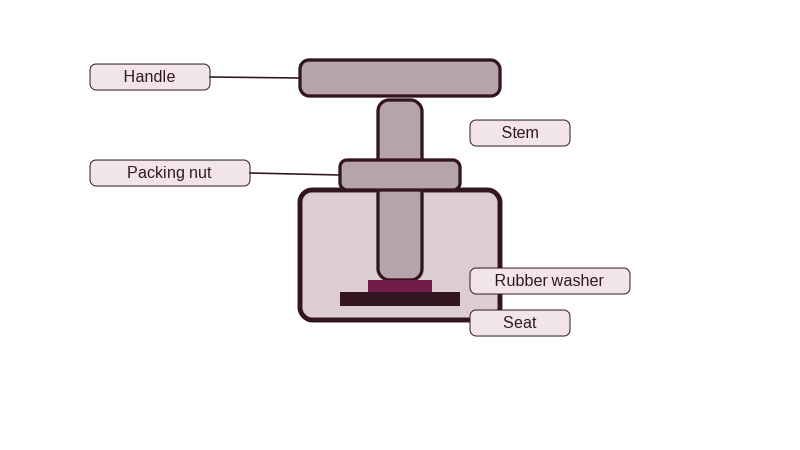
Two-handle faucets from older homes typically use compression stems with a washer at the bottom. A pitted seat inside the body can be swapped with a seat wrench or smoothed with a seat dresser. Newer two-handle faucets may use quarter-turn ceramic disc cartridges that are replaced as a unit instead of washers.
The same approach covers bathtub faucets with two handles, though the access is different. The guide on a leaky faucet with two handles gives more detail on that style.
How do I fix a single-handle bathroom faucet?
First turn the water off and remove the handle's set screw, often hidden under a small cap. Take off the handle and collar, then pull out the cartridge or ball assembly. Install an identical cartridge, or renew the seals and springs if it is a ball type. The new part must face the same direction as the old one. Reassemble and test.
Newer bathrooms often have single-handle cartridge faucets. A retaining clip or nut holds the cartridge, so note where the clip sits before removing it. For more on this type, see a single-handle faucet that leaks.
Once it is back together, open the faucet slowly with the aerator off so loose debris flushes out, then watch for drips over a few minutes. Should it still leak, the valve body or seats may be worn, and a replacement faucet may be the sounder choice.
What about the pop-up drain and the sink itself?
A pop-up stopper leaks or sticks when its rod pivot nut loosens or the gasket wears. Tighten the pivot nut behind the drain pipe, or replace the gasket. Water at the joint of drain and basin means the flange putty has failed and the drain must be reseated. A hairline crack in a vessel or porcelain sink means replacement.
Pop-up leaks are sometimes mistaken for faucet leaks because water appears in the same cabinet. Dry everything and run the basin full, then drain it, watching the joints. Hard-water scale can also seize the pop-up, which is where a vinegar soak and a gentle clean help. See removing hard water scale.
Bathroom sinks in older homes can have chrome fittings that corrode at the stop valves. A stop valve that refuses to close or seeps at the stem should not be forced. Having a plumber swap it makes every later repair easier.
Common questions
Why is it still dripping after I fixed it?
Perhaps the seat is worn, the new washer differs in size from the old one, or the cartridge never fully seated. Shut off the water, dismantle it again and confirm the part is the right size and sits facing the way the original did. A pitted seat should then be smoothed or replaced.
How wasteful is a dripping faucet?
More than you would expect over time. The EPA says the average household can lose 9,300 gallons of water or more every year to leaks, and it lists dripping faucets among the usual sources. A short repair often earns its cost back through a lower water bill.
Should I repair or replace a leaky bathroom faucet?
Repair if the faucet is in good shape and parts are easy to get. Replace if it is badly corroded, the parts are discontinued or you are bored of the style. A new faucet is a small project, but the plumber will check the stop valves while they are there. See faucet install cost.
Does the whole house supply need to be off?
Not when the sink's stop valves work. Turn each of the two little valves clockwise. If they weep, will not turn or are absent, shut the main water valve instead and have a plumber replace them, since a corroded valve can snap when forced and start a leak.