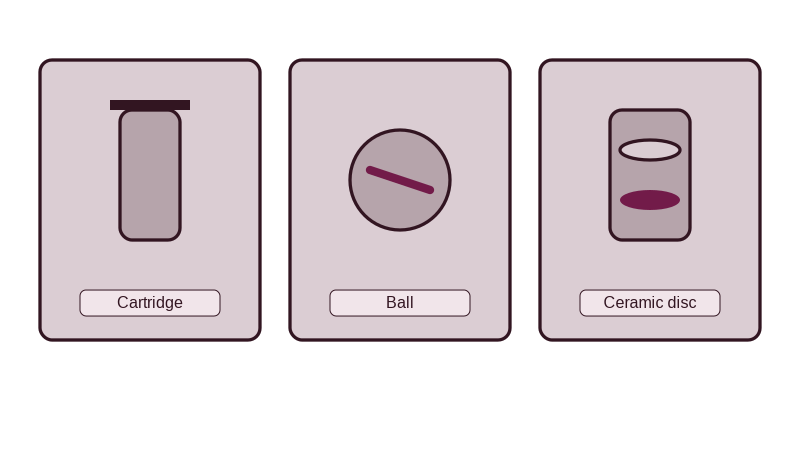
A single-handle faucet controls hot and cold through one internal valve, and the leak starts there. Close the supply, take off the handle, and identify whether the faucet uses a ceramic disc, a ball or a cartridge; then fit an exact match for the worn part. The whole job is often a short one for a careful owner. Our fixture repair page covers the other work a plumber does at the same visit, and Conejo Plumbing Pros takes requests through the quote form if you want a local plumber instead.
How can I tell what kind of single-handle faucet this is?
There are three: a cartridge faucet, with a cylinder inside the body; a ball faucet, with a slotted ball and rubber seats and springs; and a ceramic disc faucet, with a wide cylinder holding two discs. Taking off the handle and looking inside tells you. Ball types show a domed cap over a slotted ball, while disc types have a wide body.
How to tell without a manual: ball faucets have a round adjusting ring under the handle and a distinct lever with a rounded base, disc faucets are usually found on kitchen sinks with a wide, tall cylinder body, and cartridge faucets show a thin stem secured by a clip or nut. If you cannot tell, photograph it and carry the worn piece to a hardware shop.
A visible brand on the body helps: parts are usually listed by model on the maker's site. Check that before ordering anything, since parts that look alike may not fit.
How do I take the handle off?
Turn off the stop valves beneath the sink, both of them. Look for a small cap, often marked red and blue, on the front or side of the handle. Pry it off with a small flathead, and remove the screw or hex set screw beneath. Lift the handle straight up or pull it back. If it is stuck, wiggle gently and wipe off scale.
Mineral scale can hold the handle fast. Warm a rag in hot water and wrap it around the base for a minute, or soak a rag in vinegar. Do not pry hard against the finish. Keep the screw and cap in a bowl.
Once the handle is off, you will see a collar or a dome cap. Loosen it by hand, or use an adjustable wrench with a rag wrapped around the jaws so the finish stays unmarked. The type of internal part is then visible. Open the faucet to release the pressure before going further.
How do I replace a cartridge?
Remove the retaining clip or undo the retaining nut, then grip the cartridge stem with pliers and pull it straight out, rocking gently if it is stuck. Note which way it faces. Install the new cartridge in that same orientation, refit the clip or nut, replace the collar and handle, then turn on the water slowly and test.
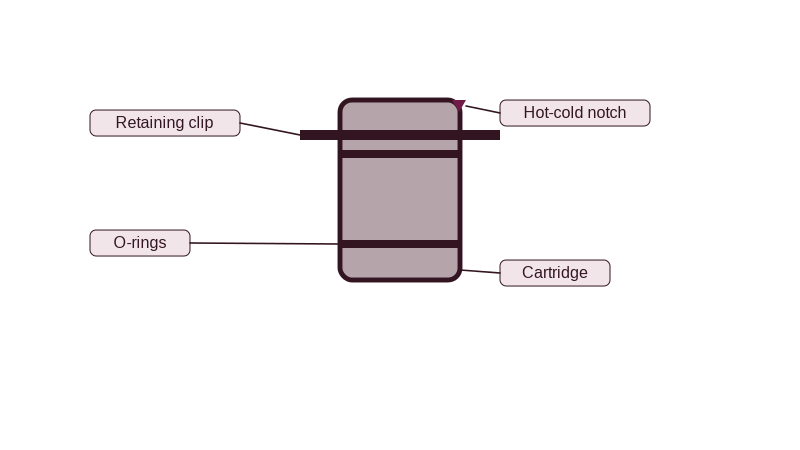
Cartridges are often the only part that wears. Check the O-rings on the outside of the cartridge too, and coat the new ones lightly with plumber's grease. A cartridge with its hot-cold notch misaligned gives reversed hot and cold, so line it up with the marks on the old one.
If scale has jammed the cartridge, a cartridge puller tool is cheap and saves damage to the body. For a mineral buildup problem on the whole fixture, read removing hard water scale from faucets.
How do I fix a ball-type or ceramic disc faucet?
A ball faucet needs new rubber seats and springs, then the O-rings, and the ball itself if worn or corroded. Repair kits are sold by brand. A ceramic disc faucet needs the whole disc cartridge and its rubber seals replaced. Clear grit out of the faucet body before fitting new parts, and check that the seats are level.
A ball faucet has many small parts, so work over a towel and lay them out in order. The adjusting ring should be snug enough to stop leaks but loose enough that the handle moves freely. For disc faucets, the rubber inlet seals often fail first and are cheap.
If you open the body and find pitting or damage in the valve cavity, replacement of the faucet is more sensible than a repair kit. A new faucet is covered in faucet replacement cost.
What causes leaks at the base or spout of a one-lever faucet?
Worn O-rings around the swivel cause a leak where the spout meets the body; lifting the spout off lets you replace them. If water drips from the spout itself, the cartridge or seats are worn. Wetness at the handle means a loose retaining nut or a worn cartridge seal. Pair the symptom with the part before buying anything.
For a kitchen faucet, the spout swivel O-rings are the typical cause of base leaks and are cheap to replace. Lift the spout after loosening a set screw, slide off the old rings, clean the grooves and fit new ones coated with grease.
If water drips only when the handle is in one position, the cartridge is probably worn. If water seeps along the handle even after replacing parts, check the body for cracks. Other styles are covered in the sink faucet leak guide and the bathroom faucet leak guide.
Common questions
How long will a single-handle repair take?
Usually brief even for a first attempt, covering shutting off the water, taking the faucet apart and testing. Stuck parts and a run to the hardware store add time. A plumber carrying the right cartridge is quicker. Plan around the time without water at that sink.
Why is the new cartridge still dripping?
Worn or scaled seats inside the body could be to blame, as could a cartridge fitted backward or not fully seated, or O-rings of the wrong size. Take it apart, clean the cavity, check orientation and compare the part with the old one. If it still leaks, consider replacing the faucet.
Must the main water valve be closed?
Only when the stop valves beneath the sink fail to close. Try them first. If they leak or refuse to turn, close the main valve and have a plumber replace them, because forcing a corroded valve risks a bigger leak. See toilet repair shut-off valve for a similar fix.
How much water does a dripping faucet waste?
It adds up. The EPA says a typical home loses more than 9,300 gallons per year to leaks, and dripping faucets rank among the most common ones. A repair is quick and cheap compared with the water lost over months. Check every faucet in the house, since one slow drip is easy to miss.