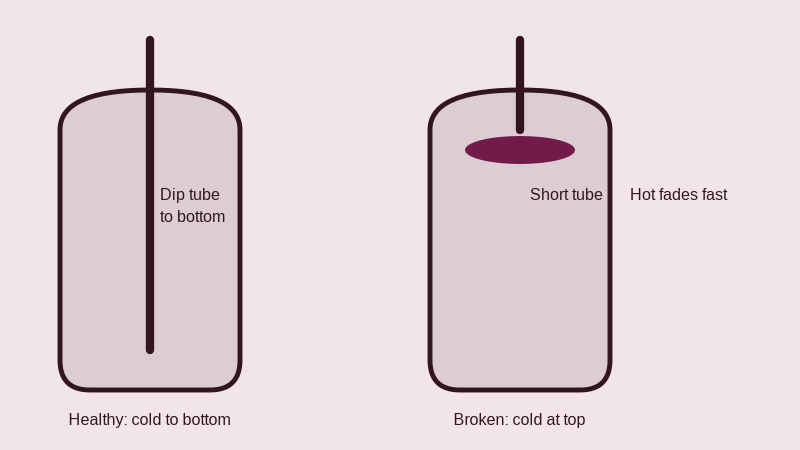
A dip tube is a plastic pipe inside a storage heater. Its job is to steer incoming cold water down to the bottom of the tank, where the burner or lower element heats it. If the tube cracks or shortens, the cold water arrives near the top and mixes with hot water about to leave. You get hot water that fades fast even though the heater keeps running. This page is part of our help on water heater repair in the Conejo Valley, and the other services appear on the home page.
What does a dip tube do?
Cold inlet water is carried down to the tank floor, so hot water, which rises, collects at the top where the outlet draws it. Without the tube, the cold inflow mixes with the hot layer high in the tank, and the tank delivers a lukewarm blend much sooner than it should.
The design works because hot water is lighter than cold. The tube makes the tank behave like layers: a hot layer on top that you draw from, and a cold layer below that is being heated. A healthy tube is why a 50 gallon tank can give you close to its rated volume of hot water. Tankless units have no tank and no dip tube, so this repair does not apply to them; see tankless repair on Navien units for that type.
How do I know the dip tube has broken?
Look for hot water that turns lukewarm after a short time, even while the burner or elements run, plus tiny white or cream-colored plastic bits in aerators, showerheads or appliance screens. Neither sign alone proves it, so a plumber checks other causes first.
Rule out the easy ones. Check that the thermostat is set properly, that a gas pilot is lit or an element is working, and that the lukewarm water is not coming from a crossed line elsewhere in the house. Sediment in the tank can produce a similar effect. Plastic fragments are the clue that points to the tube. Some older dip tubes have been reported to break down early, so an older heater is a candidate, though many tubes fail only with age.
What else causes lukewarm water that looks like a dip tube problem?
A failed lower heating element, a worn thermostat, heavy sediment, a mixing valve problem, a crossover in the plumbing, or an undersized heater for the household can all give lukewarm water. A plumber checks these before blaming the dip tube.
When only one faucet shows the problem, look at that faucet's cartridge first. If the kitchen sink is the only place, see no hot water at the kitchen tap. If the shower fades while the rest are fine, a shower that runs cold applies. When everything fades together, the tank is the suspect. Details can go in through the quote form, and mention what you see in the aerators.
Is a DIY dip tube replacement sensible?
It is possible on an electric or gas tank if you are at ease isolating power or gas and water, draining the tank partly and working on the top fittings. Many owners choose not to, because gas supply and venting sit close by and an error can cause a leak or burner problem.
The sequence is simple. Shut off the gas or power, then close the cold water valve, relieve pressure, drain some water and disconnect the cold inlet pipe; the dip tube comes out with the fitting or sits inside the nipple. Fit the new tube, reconnect, refill and check for leaks before restoring power or gas. A heater that is old, rusted at the fittings, or has seized connections is a poor candidate, and an owner should stop and ask for help instead of forcing parts. If you ever smell gas, leave the house, then reach SoCalGas on 1-800-427-2200 from outside, and use 911 when anyone is at risk.
Is a dip tube repair worth it on an aging tank?
Yes, provided the tank is otherwise healthy and the shell is not leaking. If the tank is nearing the end of its working life, has rust at the base, or has needed other repairs, the same money may go toward a new unit. Before agreeing to the repair, have the plumber state the age and condition clearly.
Use simple tests. Is the tank leaking or rusting? Is it in its second decade? Are there other faults, like a dead element or a corroded relief valve? Yes to those favors replacement; see water heater lifespan and what a replacement costs. A no to all means a small repair may extend the tank's life. Written quotes covering both options let you decide with numbers.
What does the plumber do to swap a dip tube?
After confirming the diagnosis, the plumber shuts off fuel and water, partly drains the tank, removes the inlet fitting, swaps the tube, and often renews the inlet nipple at the same time since it is accessible. After refilling, the plumber purges air, checks for leaks, and restores gas or power.
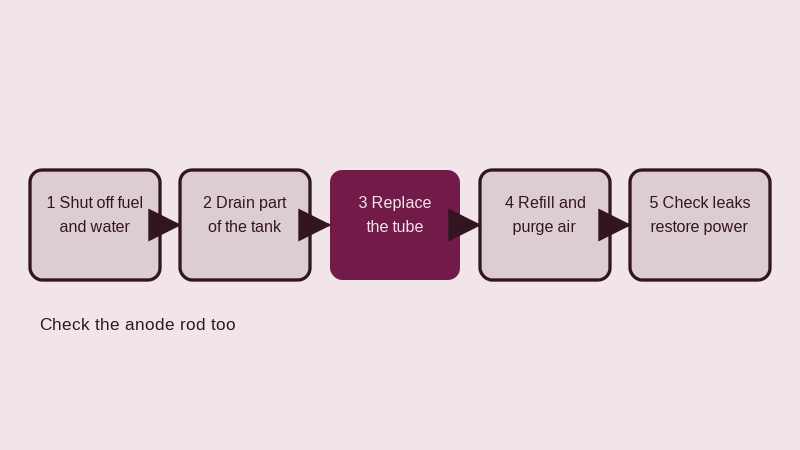
Because the top of the tank is already open, many plumbers inspect or renew the anode rod too, as it is within reach and cheaper than a return visit; see anode rod replacement. The job is usually short, a single visit for a tank that is otherwise sound. If the plumber finds heavy corrosion at the fittings, the conversation may shift to replacing the tank.
Common questions
How long does replacing a dip tube take?
The visit is usually short, since the work happens at the top of the heater. Most of the time goes to draining part of the tank and refilling it. Corroded tank connections make the job longer. Ask for a time estimate and how long the hot water will be off.
What should I ask before hiring for a dip tube job?
Ask whether the plumber will confirm the cause before swapping parts, whether the inlet nipple and anode rod get checked, what the price includes, and what happens if the tank proves to be failing. Get the contractor license number and look it up with the state board.
Do plastic bits in my faucet mean the dip tube failed?
They are a strong sign, especially in an older heater, but not proof. Other debris, such as sediment or pieces of old fittings, can look similar. A plumber can inspect the aerator, then the tube. Replace the tube before the fragments clog fixtures and appliance valves.
Is there a dip tube in a tankless heater?
No, since a tankless unit holds no stored water, there is nothing to fit one to. Lukewarm output from a tankless unit is more likely to trace to scale, flow, trouble with the gas supply, or a fault code. A plumber diagnoses those, and some owners can flush the unit if the manual allows.