Most people have walked past their regulator for years without knowing it. It is not hidden, but it does not look like a faucet, and nobody labels it. If your pressure is odd, a plumber will ask you to find it, and a short description saves time. This page sits under our help with water pressure and valves from Conejo Plumbing Pros, and it is all about identification: shape, color, location and the look-alikes to rule out.
How can I recognize a pressure regulator by sight?
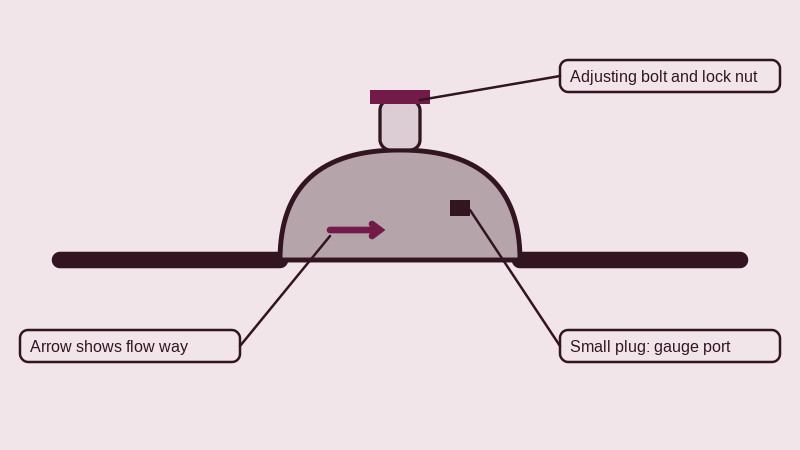
A typical regulator is a bell or dome-shaped body in brass or bronze, about the size of a large fist or a small bottle. It has a threaded cap on top, with a bolt or screw and a lock nut, and an arrow cast on the side showing the direction of flow. Water pipes connect at both ends.
Newer ones may have a gauge port, a small plug on the side for testing. Some are painted or have a plastic cap, and some are small enough to hide behind a pipe. The adjusting bolt on top is the clearest sign: turning it changes the pressure.
If the unit is dull green or chalky, that is corrosion or mineral crust on old brass, and not necessarily a fault. Do not wrench on a crusty valve until you know what you are looking at, since old fittings can break when disturbed.
How is it different from the water meter, shut-off and other valves?
The meter is a round or square housing with a dial or numbers, usually near the street, and belongs to the water supplier. The shut-off is a handle, either a round wheel or a lever. A regulator has a domed top with an adjusting bolt and no handle. The water heater's relief valve is a different part, smaller and fitted with a lever.
The expansion tank, if there is one, is a small metal tank, often blue or gray, mounted on the water heater's cold line, shaped like a small propane tank. A backflow device, often seen on irrigation lines, has two shut-off handles and test ports. A hose bib is the outdoor faucet.
Our page on 3/4 inch regulators explains the sizing and replacement of the regulator itself, once you have found it. If you are unsure which part is which, take a photo and ask the plumber.
How can you tell if the one you found is working?
Attach a gauge to a hose bib and record the static pressure while nothing is running in the house. A steady reading inside the range your fixtures list means the regulator is likely working. If it creeps up overnight or is very high, it may be failing.
Check for signs on the regulator itself: water around the cap, a hissing sound, a crusty buildup or a loose bolt. A regulator that weeps at the cap has a failed diaphragm and needs replacing. If you hear whistling or humming from it, that may be worn parts or high flow.
For noisy pipes and pressure swings, also read about water hammer sound, which can come from the same causes.
Where in a house does it sit?
Check the main water line just past the main shut-off valve, where the pipe comes into the house. In a Conejo Valley home that is often a garage, an exterior wall, a side yard, a utility closet or a below-grade box toward the front of the house.
Begin at the main shut-off. In homes with slab foundations, the line commonly rises out of the ground near the front of the house, by the water heater or garage wall. In homes with crawl spaces it may be under the house, near the access hatch.
Walk the pipe from the street. Water comes from the meter to a shut-off valve, then possibly a regulator and then the house lines. Some have a pressure gauge next to the regulator, which is a good sign. On hillsides, pressure can vary with elevation, so a house may have one fitted; check rather than assume.
What do the parts of a regulator do?
The adjusting bolt sets the spring tension, the spring pushes on a diaphragm, and the diaphragm moves a valve disc to restrict flow. The strainer, on some models, catches grit. The body is brass, designed to resist corrosion, and the bell shape holds the spring and diaphragm.
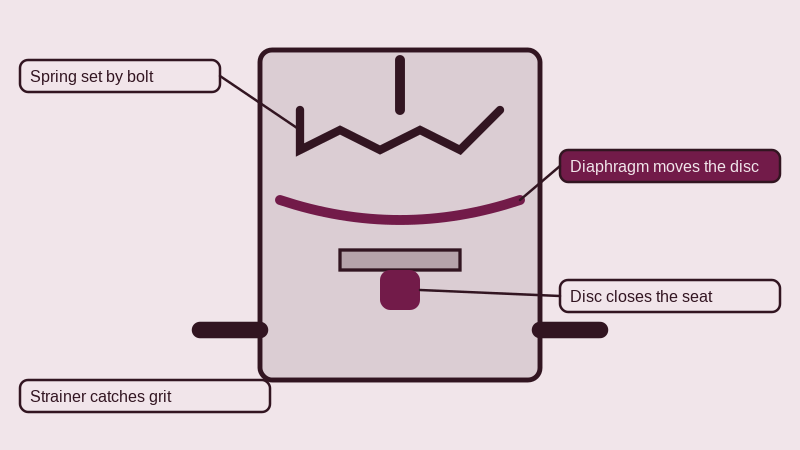
Excess pressure downstream makes the diaphragm push the disc shut, and a drop lets the spring open it again. A worn diaphragm is why pressure drifts. A regulator that feels stuck may have grit or scale blocking the seat.
You do not need to remember this to use a regulator. It is useful to know that it is a mechanical device with parts that wear. See burst pipe prevention for what high pressure does over time.
When should a plumber take a look?
Get help if you cannot find the regulator, the gauge reads very high or very low, water shows at the regulator, the pipe is corroded or the shut-off valve refuses to close. The same applies if you plan to adjust it and the lock nut is seized.
A single visit lets a plumber confirm the part you found is a regulator, check pressure, test the water heater's relief valve and look at expansion issues. Photograph what you found and the gauge reading before you ask.
On the quote form you describe what you see, and we pass the request to local plumbing businesses, which pay us a fee for accepting requests. Requests are handled on weekdays, 9am to 5pm.
What if you cannot find one?
Some homes have no regulator, especially where street pressure is low or the house is older. Others keep one at the meter, installed by the supplier, or in a box. When nothing turns up, check pressure with a gauge. A high reading makes a regulator worth adding.
A missing regulator is not always a problem. Pressure inside the normal range for your fixtures may mean you need none. A high reading can be handled by a plumber adding one to the main line, a simple job in most homes.
In houses with private wells, as in parts of Hidden Valley and Lake Sherwood, the pressure tank and switch control the range, and a regulator may sit after the tank. Ask about the equipment that serves your property when you request a quote.
Common questions
Is the regulator just another name for the main shut-off valve?
No. The shut-off stops all water into the house and has a handle. The regulator reduces pressure and has a bell-shaped body with an adjusting bolt on top. They often sit near each other, so it is easy to mix them up, but only the shut-off has a handle or lever.
Are regulators always brass?
Most are brass or bronze, because those metals resist corrosion, but some newer models have plastic parts such as caps. Look for the bell shape, the adjusting bolt and the flow arrow rather than relying on color. Old brass may look dull green or dark.
Can I see the pressure on the regulator?
Only if it has a gauge. Many do not. A gauge costs little and screws onto a hose bib, which gives you a reading without touching the regulator. If your regulator has a gauge port, a plumber can fit a permanent gauge there.
Must someone be home for a pressure check?
Yes, someone should point out the main shut-off and the regulator to the plumber, and listen to the findings. The water may go off briefly if a part is replaced. Keep the way clear to the garage or wherever the main line enters, and mention any pets to the plumber.