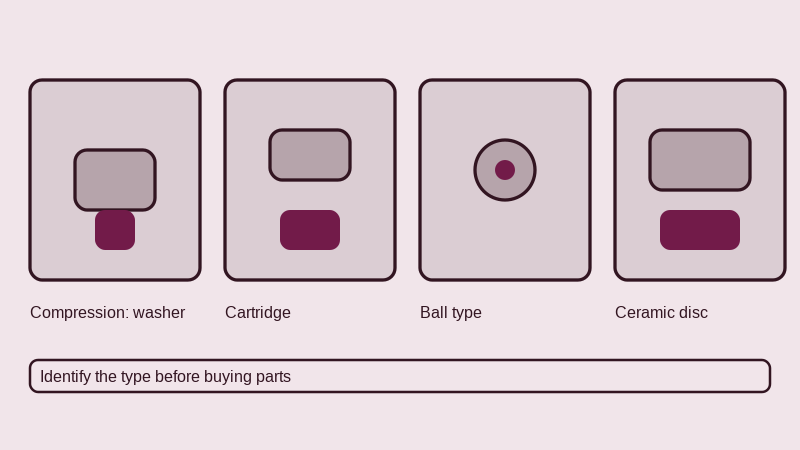
Fixing a leaky faucet means closing its water supply, dismantling the handle, swapping the worn component inside and reassembling. Two-handle compression faucets use a rubber washer for that component. Most single-handle models instead hold a cartridge, a ball assembly or a ceramic disc. The wider service is covered on our page for faucet, sink, shower and disposal work. Below, you will find which type you have, what each repair looks like and the point where calling a local plumber is cheaper than another trip to the hardware store.
Which type of faucet is yours?
Count the handles and watch how they move. Two handles turned through several rotations are usually compression faucets with washers. One lever that swings left and right and also tilts up and down signals a cartridge, a ball or a ceramic disc inside. A ball faucet shows a rounded cap beneath the handle, and a disc faucet has a wide cylindrical body.
Still unsure? Remove the decorative cap and handle screw and see what lies underneath. A brand name stamped on the body helps, because makers sell exact replacement parts. Take the old part to the shop, or photograph it, so the replacement matches.
Shut the water off before anything else. Beneath the sink, turn the oval shut-off valves clockwise. After that, open the faucet to bleed off pressure. Plug the drain with a rag so a small screw cannot fall in. Wondering why a drip matters? The EPA reports that an average household loses more than 9,300 gallons of water a year to leaks.
How do you repair a dripping compression faucet?
A worn rubber washer or seat is the usual reason a two-handle faucet drips from the spout. Remove the handle and unscrew the packing nut, then pull out the stem. At its base, change the rubber washer, and the O-ring too if it has worn, before reassembling. If the seat inside the body is pitted, a seat tool can smooth it, or it can be replaced.
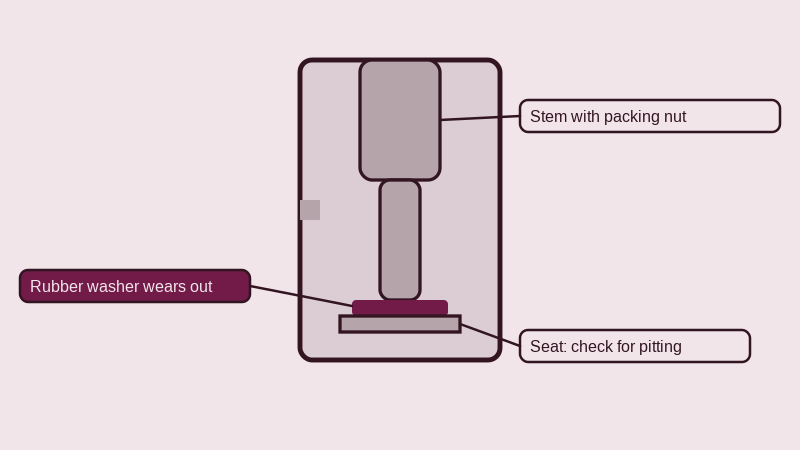
Get the washer size exactly right, because one too small or too large will leak again. Brass screws on old stems can seize. Penetrating oil helps, and gentle force avoids snapping the stem.
Water escaping around the handle instead of the spout implicates the packing or an O-ring. A slight tightening of the packing nut sometimes stops it. When the faucet is very old and parts are scarce, swapping the entire faucet is often simpler. Our faucet replacement cost guide explains what that involves.
What stops a single-handle kitchen faucet leaking?
A cartridge sits inside most single-handle kitchen faucets. Begin with the water off. Remove the handle along with whatever clip or nut holds the cartridge, then pull the cartridge straight out. Install an identical new one, fresh O-rings smeared lightly with plumber's grease. Reassemble, and turn the water back on slowly. A drip that persists suggests a worn body or seat.
Shop with the old cartridge in hand to find an exact match. Cartridges look alike but differ in length, spline count and flow. A wrong one leaks or restricts the handle. If your faucet is a ball type, the repair kit includes springs, seats and a ball. Ceramic disc faucets use a sealed disc cylinder that is replaced as a unit.
Two more guides go deeper on the single-handle case: a single-handle faucet that drips and leaky kitchen faucets.
How is a leaky Moen bathroom faucet repaired?
Many Moen single-handle faucets have a cartridge held in by a metal retaining clip. Shut off the supply first. Remove the handle and ease the clip free with pliers. A cartridge puller or pliers then draws the cartridge straight up, and the new one goes in facing the same direction. Check the model on the faucet or in the manual before buying a cartridge.
Manufacturers publish parts diagrams, and a model number gets you the exact part. Note the orientation of the cartridge, since it is easy to install it rotated, which swaps hot and cold or limits the temperature. Some Moen cartridges have a hot-limit stop. Replace the O-rings when you replace the cartridge.
Water seeping from the spout base most likely means worn O-rings on the spout body. Lift the spout off, replace them and give them a light coat of grease.
What fixes a dripping shower faucet?
A dripping shower typically has a worn cartridge or stem behind the handle. Without local shut-offs, the whole house has to be turned off at the main. The handle and trim plate come away next, and then the cartridge is pulled and replaced. Drips coming from the wall or the tub spout may point to the valve or a diverter, and a plumber should look.
Shower valves sit inside the wall, so closing the house main is often needed. Our guides to repairing a leaky shower faucet and a leaky Delta shower faucet go through them. A stained wall or ceiling below the shower is covered under plumber for a shower leak.
Could the leak be a pipe under the sink?
Moisture at the base of the faucet or in the cabinet calls for inspecting the supply lines and drain before blaming the faucet. Wipe everything dry, wrap dry tissue around each joint, and run the tap. The steps are laid out on our page about a pipe leaking beneath the basin.
Supply lines below the faucet often fail. A braided line that is kinked, rusted at the nut or bulging needs replacing. If the faucet is old, swap it while the cartridge is out.
When should you call a plumber?
Hire a plumber when the shut-off valves will not close, the faucet body is corroded or cracked, parts are obsolete, the leak returns after a repair, or water is getting inside the wall. Another reason is simply wanting the job done right when a weekend is not available.
We do not do plumbing ourselves. Conejo Plumbing Pros arranges for a local plumber to visit. Past a certain job size, a contractor license is generally required in California, and cslb.ca.gov lets you verify one. A faucet repair rarely needs a permit. Use our quote form and add the faucet brand and a photo, which helps the plumber bring parts.
Older houses in Thousand Oaks and Newbury Park may have original fixtures and shut-off valves, which can be stiff and sometimes fail when touched. Do not force them. Shut the main and ask for help.
Common questions
How much time does fixing a dripping faucet take?
Swapping a washer or cartridge takes an experienced person under an hour, and a plumber needs about the same. Seized parts, missing shut-offs or a mismatched cartridge add time. Allow a morning for a first attempt, and keep the old part for matching against the new one at the store.
Which questions come first when hiring for faucet work?
Ask whether the price is flat or hourly, how large the call-out fee is, whether parts are included, and whether worn supply lines get replaced during the same visit. Get the contractor license number and check it at cslb.ca.gov. The written quote should arrive before any work begins.
Must someone be at the house?
Usually yes, at least at the start, so the plumber can inspect the faucet, agree a price and reach the shut-offs. Clear out the cabinet below the basin ahead of time. When you cannot be there, arrange access through someone you trust and send photos in advance.
Is it worth repairing an old faucet?
When the faucet is in good shape and parts exist, repair costs little. If it is corroded, pitted or unsupported by parts, replacement wins. A new faucet also lets you fit fresh supply lines and shut-off valves at once. A plumber can advise which route makes sense for your sink.
Why does it keep dripping once I have repaired it?
Usual causes are a cartridge that went in rotated or unseated, a washer in the wrong size, a damaged valve seat or a pinched O-ring. Take it apart again, check each part and clean the seat. If it still drips, the body may be worn and a plumber can assess it.