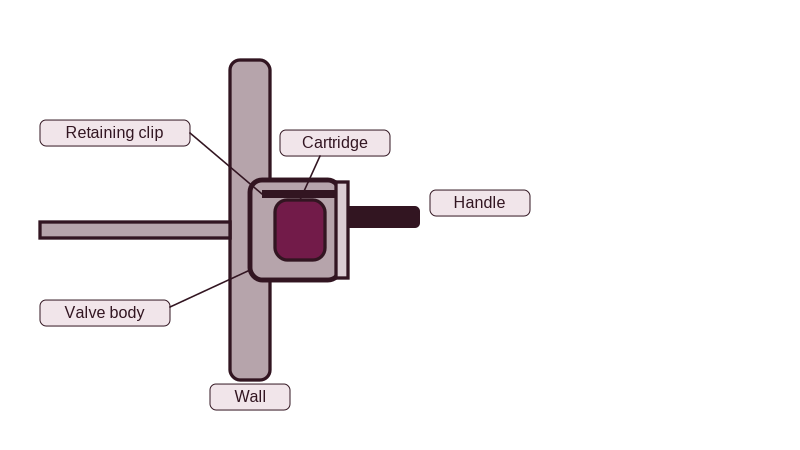
A Delta shower that drips at the head, runs lukewarm or leaks at the handle almost always has a worn cartridge, or tired seats and springs if the valve is an older ball type. The fix is to shut off the water, remove the handle and trim, pull the old part and install the correct one. Identify the valve first, and you avoid a wasted trip to the store. For a leak behind the wall, see the faucets and fixtures section or ask for a plumber.
Which Delta valve do I have, and how can I tell?
Delta has used several designs, and their parts do not interchange. Clues come from the handle style, the trim, and the shape of the cartridge once the handle is off. A model number is often stamped on the cartridge or printed in the paperwork. If you cannot identify it, take the old cartridge, or a clear photo, to a supplier.
Look at it this way:
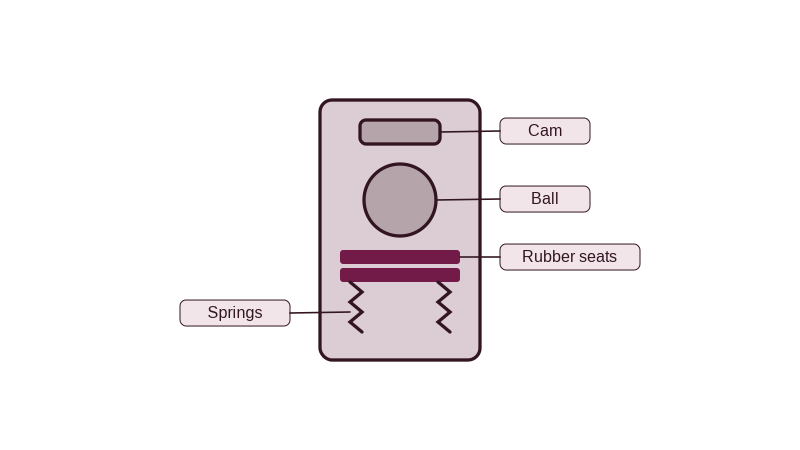
- Single handle with a ball inside: an older design, with a ball, seats, springs and a cam.
- Single handle with a cartridge secured by a clip or nut: a cartridge type, now common.
- Two-handle or three-handle showers: stem-type, with separate hot and cold parts.
- A temperature limit stop behind the handle: common on pressure-balancing cartridges.
Delta publishes parts diagrams for its own models, and many hardware stores stock the common cartridges. Because we have not checked the maker's current parts list, we do not name part numbers here. Use the maker's lookup, or the model number on the old part, and follow the instructions in the box.
Why does a Delta shower faucet leak or drip?
The usual cause is wear: rubber seats and springs harden, a cartridge's seals roughen, or scale builds up on the moving parts. You then see a drip from the head with the shower off, a leak around the handle, or hot and cold mixing together. Hard water speeds it up.
What each symptom points to:
- Drip from the shower head after it is off: cartridge or seats and springs not sealing.
- Water around the handle: a worn seal or a loose retaining nut.
- Water that will not get hot or goes scalding: a worn or misadjusted cartridge or its temperature limit stop.
- Water that leaks from the tub spout when the shower runs: a worn diverter, a separate part.
Check for scale. A soak in white vinegar often frees a gritty cartridge enough to buy time. If the cartridge is badly pitted, replace it.
What are the steps for changing the cartridge or seats?
Turn the water off, run the shower to empty the line, then take off the handle, trim plate and retaining clip or nut. Draw the cartridge directly out, noting its orientation, and seat the new one the same way, with fresh grease on the seals. For a ball-type valve, replace the seats and springs and the cam together.
A numbered sequence:
- Close the water at a local shutoff, or use the main when none exists.
- Open the shower valve to relieve pressure.
- Remove the handle by loosening a set screw, often behind a small cap, with a hex key.
- Unscrew the trim, or escutcheon, which exposes the valve.
- Remove the retaining clip or the bonnet nut. Keep them safe.
- Pull out the cartridge. Use a puller if it sticks, but do not force it sideways.
- Compare the new part with the old one, line up the notches and push it home.
- Refit the clip or nut, trim and handle.
- Turn the water on slowly with the valve in the open position, to let air out.
- Check for drips for a day.
For a ball-type valve, lift out the cam, ball and the two rubber seats with springs, and use the exact replacement kit. Inspect the inside of the valve body for scale or debris and clean it with a rag.
Never force the handle against a stop. Our companion pages on a leaky bath faucet and a two-handle leaky faucet explain the other types.
What if it still leaks after the swap?
Check that the cartridge sits fully home, that the retaining clip is seated, that the seals are not pinched, and that the temperature limit stop is set. A drip that persists suggests the valve body seat is worn or cracked, or the cartridge is the wrong one. Then a plumber should look, because a new valve body means opening the wall.
Common slip-ups include fitting the cartridge turned half a revolution, which reverses hot and cold, forgetting to remove the old O-ring, and reusing a bent clip. Take your time and compare with the old part. If the cartridge sticks and breaks apart, leave the pieces and do not dig with a screwdriver.
At what stage does a plumber become necessary?
A plumber is needed if the shutoff will not close, the cartridge refuses to release, the valve body has corroded, the leak shows as a ceiling or wall stain, or the shower is tiled in with no access panel. Replacing a valve body means opening the wall and often the tile, and that is plumber and tiler work.
Many Thousand Oaks and Newbury Park homes were built over the four decades from the 1960s to the late 1990s, so original valves are common, and some are of a style no longer made. A plumber can retrofit a modern valve, though it may mean opening the back of the wall from an adjoining room. Our page on shower leak help explains how a pan or valve leak shows itself.
If you are also thinking of a remodel, see plumbing for a bathroom remodel, where a new valve is easier to fit while the wall is open.
Will water pressure or hardness shorten a cartridge's life?
Yes. High supply pressure stresses seals, and hard water scales the moving parts. Thread a gauge onto a hose bib and read the pressure. If it is high, a regulator protects the shower and every other fixture. A softener or regular cleaning handles scale. Find which water provider serves your street, and read its annual water report for hardness.
On the pressure side, see water pressure regulator replacement; for scale, read our page on hard water scale prevention.
Common questions
How long does fixing a leaky Delta shower take?
On a first attempt, a cartridge swap takes roughly an hour once you hold the right part. Add time to identify the valve and visit a store. A plumber is usually faster. A new valve body makes the job longer because of wall and tile work, and you should ask for a schedule.
Which tools will I need?
Usually a hex key for the handle screw, a screwdriver, pliers and an adjustable wrench. A few cartridges require a puller tool, and some need a special socket for a bonnet nut. Many stores sell or lend these. A rag in the tub drain stops small parts disappearing, and a flashlight helps in a dark wall cavity.
Is a shower leak an emergency?
A drip from the head is not, but a leak inside the wall can damage framing and ceilings below, so act soon. If water is spreading, close the shower's shutoff, or the main. Our guide to knowing if a pipe has burst lists the signs that matter.
Can I replace the whole valve myself?
If the wall is open, perhaps. If it is tiled, replacing the valve body means cutting into the wall and soldering or fitting new connections, which most owners leave to a plumber. The work may also involve permits depending on the jurisdiction. Ask City of Thousand Oaks Building and Safety, or the Ventura County Resource Management Agency.
How do I request a plumber for this job?
Open the price request page, say it is a Delta valve, add the model if known, and describe where it leaks. A local plumber comes out and provides a written quote. For other jobs, begin at Conejo Plumbing Pros.