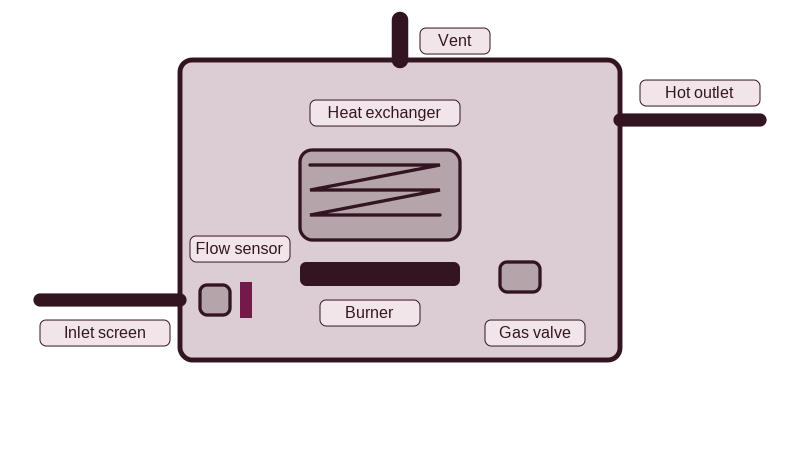
With no tank to run dry, an instant water heater (also named a tankless or on-demand unit) shows a failure immediately. Typical culprits include scale inside the heat exchanger, a clogged vent or air intake, a flow sensor that fails to register, ignition or electrical trouble, and ordinary wear. The water heater plumber page covers the whole range of heater work.
What happens during an instant water heater repair?
The error code is where most repairs begin. It tells a plumber if the trouble lies with ignition, flow, venting, temperature or a sensor. Next come checks of the gas and water supply, a clean of the intake screen, sensor tests and a look at the vent. Descaling the heat exchanger frequently cures a unit that cuts out or whose output temperature swings.
Typical faults and fixes:
- Lukewarm water that turns cold: low flow through the unit, a clogged cold inlet screen or scale. Cleaning or flushing often solves it.
- Error code and no heat: a flame sensor, igniter, gas valve, or vent problem. These are gas parts, so a plumber or appliance contractor should handle them.
- Hot for a moment, then cold: flow falls below what keeps the unit lit, which may also trace back to a fixture with a very low flow aerator.
- Water too hot or temperature swings: a thermistor or flow control fault.
- Nothing at all: a lost power supply, a tripped breaker, or a shut gas or water valve.
Many models take parts that come from the maker, and stock decides how quickly a repair ends. Guides for particular brands are on this site: Navien, Rinnai, Rheem and Noritz.
What can I check myself before I send a request?
A few basics are safe to inspect: the power switch, the breaker, the heater's gas valve (a handle lying along the pipe means open), the cold water shutoff and any code on the panel. Note the code on paper and find its meaning in the manual. Only clean the inlet screen after closing the water and following the manual.
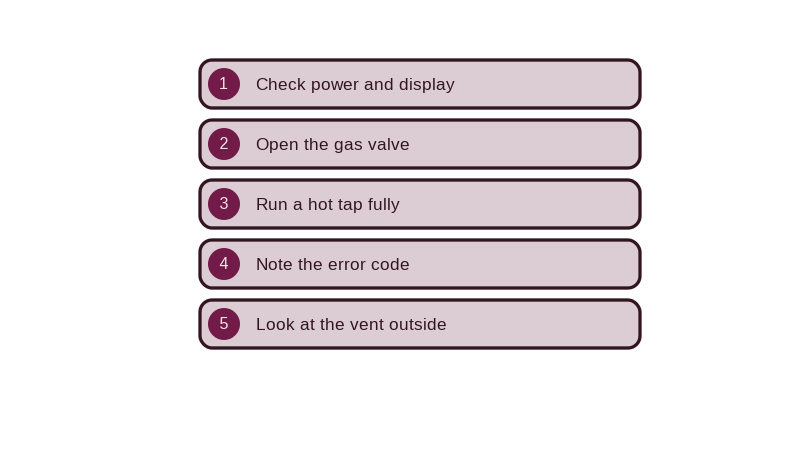
Do these in order:
- Confirm the display lights up and there is power.
- Check the gas shutoff and, if you have gas at other appliances, that the range works.
- Run a hot tap fully open. A lot of units will not ignite below a certain flow, so a barely open tap can mislead you.
- Note the code and when it appears: at start, after a minute, or at high use.
- Look at the vent outside for blockage by a nest or debris, without climbing on a roof.
Stop there. Leave the gas side closed, never bypass a sensor and keep the cover on a gas unit. Gas appliance work is for a contractor.
When is it a gas or safety problem?
If you smell gas, or a sulfur odor near the heater, leave the building. Once outside, call SoCalGas on 1-800-427-2200, and use 911 if anyone is in danger. Do not touch any switches. Soot, scorch marks near the vent, or a yellow flame also mean stop using the unit until a plumber looks.
Exhaust gases can build up indoors when a vent is blocked or loose, so vent error codes deserve serious treatment. Placing a carbon monoxide alarm close to the heater and the bedrooms is a sensible precaution, and after any repair a plumber can confirm the heater vents properly.
Is it better to repair or replace an instant water heater?
Fixing the unit is reasonable if it is fairly new and one part, like a sensor or igniter, is at fault. A new heater deserves discussion once the heat exchanger has died, parts are scarce, or errors keep coming back. Get the diagnosis written down and set it beside the price of a new unit.
Tankless units are generally expected to outlast a tank model, so a repair on a mid-life unit is often worth doing, provided it has been flushed on schedule. Hard scale is the main reason these units fail early, and it builds faster when the heater is never flushed. Compare costs on our pages for water heater replacement and tankless water heater replacement.
Tankless heaters usually hang in a garage or on an outside wall. Where one took the place of an old tank in a cramped spot, the vent run can be awkward, which affects repair access and any later swap. An older unit makes parts supply matter more, so record the model and age ahead of requesting a quote.
What to do next
Collect the model, the error code, the date the trouble began and whether the unit was ever flushed. Photograph the data plate. Then submit the quote page form so a local plumbing business can price the visit. A heater leaking at its base needs its water supply and power turned off, followed by a request for an urgent visit.
Among several hot water complaints, our guides to a heater that runs but produces no hot water and hot water missing at the shower alone help you tell heater faults from fixture faults.
Common questions
How much time does an instant water heater repair need?
One visit can cover a cleaning or a sensor swap, though ordered parts stretch it out. A full descale runs longer, since cleaner must circulate through the heat exchanger for a while. Once the fault is known, expect the plumber to offer a rough time and to say whether a part must come from the manufacturer.
What should I ask a tankless heater repairer?
Establish whether they have handled your brand before, whether diagnosis carries its own fee, if parts are in the price, who orders them, and what warranty covers the labor and the part. Have them go through the error code with you. Ask for the contractor license number and check it with the state board.
Must an adult be home during the repair?
Yes. An adult should be home to give access and sign off on any change of plan. At some point the plumber will switch off gas, water and power, so there is no hot water during the visit. Move things away from the heater beforehand, and mention known problems such as a loose vent.
Can I flush a tankless heater myself?
Some owners do, using a small pump, hoses and descaling solution, and the maker's manual lists the steps for each model. Valves must be closed in the right sequence, so one slip can flood the garage. If you are unsure, let a plumber do the first flush and observe each step.