When a heater appears to be running but gives no hot water, the likely culprits are a failed heating part, a thermostat or control fault, a tripped breaker or safety, a closed or broken valve, or a problem in the pipes after the heater. Which one depends on whether you have a gas tank, an electric tank or a tankless unit. Our water heater repair page covers the whole service. Below is a short order of checks, what each result means, and the point at which to stop and let a plumber look.
Why would a water heater work but give no hot water?
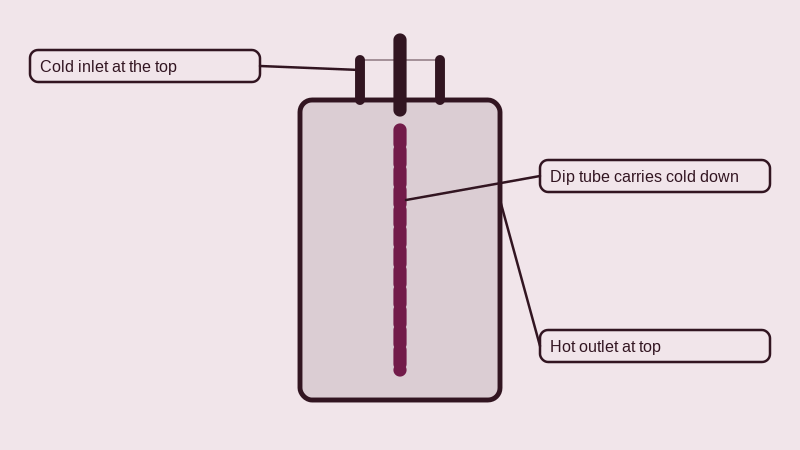
Either the heater is heating but the hot water never reaches you, or it shows power while a part inside has failed. Common causes include a dead element in an electric tank, a failing gas control or thermocouple, a snapped dip tube, a stuck mixing valve or a crossed hot and cold connection after other plumbing work.
Each of these has a recognizable pattern. When a dip tube breaks, cold supply water mixes into the hot layer near the top, so you get lukewarm water and short supplies. A failed thermocouple shuts the gas off when it senses no flame. A single bad faucet cartridge, by contrast, can leave one fixture cold while the rest are fine.
That last point is the quickest test. If every hot tap throughout the home is cold, suspect the heater. If only one is cold, suspect that fixture. Single-fixture cases have their own guides: a kitchen tap that stays cold and a shower that never warms up.
What can you safely check yourself?
You can check the breaker or the gas supply valve, look at the thermostat setting, and see if the heater is on. Do not open gas lines, light pilots where there is a gas smell, or remove electrical covers with the power on. If gas is present, leave the building and, once outside, contact SoCalGas at 1-800-427-2200.
For an electric tank, look at the breaker first. If it has tripped, switch it off fully then on again once. Next check the thermostat dial, and the red reset button that sits behind the access panel, but only with the breaker off. A breaker that trips again means a fault, and you should leave it.
On a gas tank, start with the control. Many models show a status light or a pilot window. If the pilot is out, follow the relighting steps printed on the tank, but give up if the flame will not hold, a symptom that often means a worn thermocouple. A gas smell, a yellow flame or soot around the burner are reasons to call, not to experiment.
On a tankless water heater, many models show a fault code, which points straight to the problem, so note it. Brand pages such as our Rinnai tankless repair explain how codes are used.
Is the tank empty, cold or leaking?
Inspect the tank: puddles beneath it, rust around the base or a dripping relief valve all matter. A leaking tank will not recover, and shutting off the heater and its cold supply stops the damage. If the tank is cold and dry-sounding, it may not be filling, which can mean a closed cold supply valve or a clogged inlet.
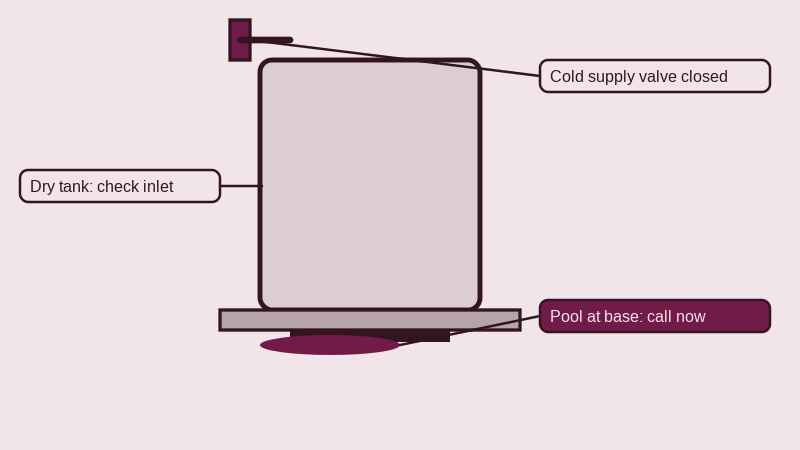
Standing water or rust at the bottom is a serious sign. A tank that has corroded through cannot be repaired; the fix is replacement. Close the cold supply valve above the heater, switch off the power or set the gas control to off, and mention the leak when you book. The guide to repairing a water heater leak explains what is fixable and what is not.
A relief valve discharging steadily is not a drip to ignore. It signals excess temperature or pressure, so have a plumber examine it promptly.
Could sediment or age be the problem?
Yes. Sediment settles on the tank floor, insulates the burner or elements, and reduces the hot water available, while an old tank can also lose its anode rod protection and corrode. Flushing can restore performance if the heater is otherwise healthy, but a very old heater may be better replaced.
We have not checked a supplier report for any specific area, so we cannot give a hardness figure for your street. The practical tell is sediment in the drain water or a rumbling noise as the heater runs. Our anode rod guide and replacement timing guide go further.
Gas heaters in Thousand Oaks and elsewhere in the Conejo Valley are common, but whether gas service reaches your street is something to confirm with SoCalGas rather than assume.
At what point should a plumber step in?
Get a plumber once the breaker or pilot has been checked and there is still no hot water, the heater trips repeatedly, you see a leak, rust or a discharging relief valve, or you smell gas. Replacing a heater generally calls for a permit, gas work is for a contractor, and the state licensing board's website lets you verify a contractor's California license.
We do not do the work ourselves; a local plumbing business is set up to visit your home. Put the details into the quote form: fuel type, age if known, what you checked and what you saw. A plumber arriving with the right parts saves a second trip. Permits for a replacement run through City of Thousand Oaks Building and Safety in the city, or the Ventura County Resource Management Agency in unincorporated areas.
Conejo Plumbing Pros can include access notes, such as a heater in a tight garage closet or an attic, so the plumber is prepared.
Common questions
How much time does a no-hot-water repair take?
Simple fixes such as a reset, a thermocouple or an element are often done in one visit of roughly one to two hours. A heater replacement takes longer, commonly a few hours plus time for the tank to heat. A permit and inspection may add days. Before work starts, ask the plumber for a realistic time.
What should I ask before hiring someone to repair a water heater?
Get the contractor license number and look it up at cslb.ca.gov. Then ask what the diagnostic or call-out fee is, whether it comes off the bill if you go ahead, how repair compares with replacement, and whether the price is in writing. Bring up permits as well if a replacement looks likely.
Does someone need to be at home for the repair?
An adult needs to be there to let the plumber get to the heater and to approve the price once the fault is found. If the heater is in a locked garage or an attic, sort out access beforehand. A readable tank label and a clear area help the visit go faster.
Why is the hot water gone after a power cut?
After an outage, an electric heater may need its breaker or reset button checked, while a gas model with a pilot may need relighting. Many modern gas heaters relight themselves. If the heater does not recover after a reset, a plumber should check the controls, because a tripped safety can hide a fault.
Could the problem be my mixing valve or fixtures?
Yes. A mixing valve or a single failed shower cartridge can leave one area cold while the heater is fine. When only one fixture is affected, the heater is probably not the cause. When every hot tap runs cold, start with the heater.