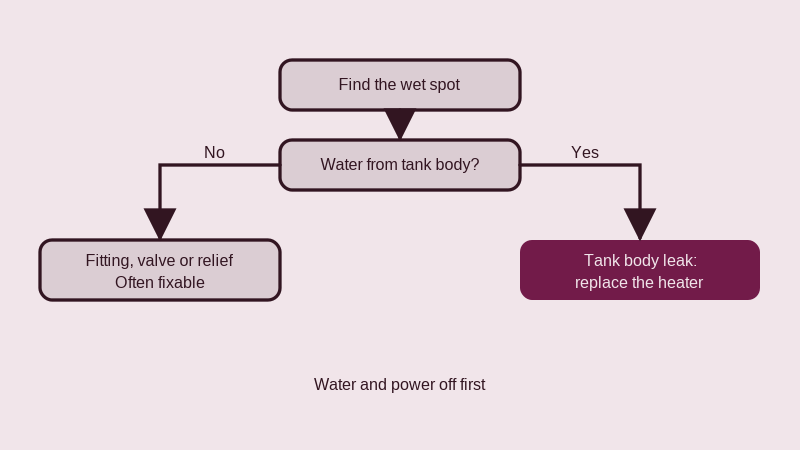
Puddles near a water heater cause alarm, yet not every leak is a dead tank. Some come from a loose fitting or a relief valve, and those can be repaired. Others come from the tank itself, and no patch will hold. This guide is part of the section on replacing and repairing water heaters for Thousand Oaks and Conejo Valley homes, and it guides you to the source before any money is spent.
It also answers a question that often follows a failed heater: whether to install a tankless unit yourself.
What do I do first when my water heater begins to leak?
Safety first, then the source. Close the heater's cold water supply, cut the electricity at the breaker or turn the gas control off, and set a bucket or towels beneath the leak. If the leak is heavy, shut the main water valve for the whole house as well.
Keep away from wires or panels near water. On a gas heater, a gas smell means leaving the building, then reaching SoCalGas on 1-800-427-2200 from outside, with 911 if anyone is at risk. Once everything is off, dry the area and watch for the first new drip. That tells you where to look. If you have to leave the heater off for a while, open a hot tap to ease pressure so a stuck valve does not make things worse.
How can I find where a water heater leak starts?
Towel the heater and its pipes dry, then wrap dry tissue around every joint and watch for the first wet spot. Check the connections on top, the relief valve and its discharge pipe, the drain valve near the bottom of the tank, and the base. Water from the base or the inside of the jacket is the worst sign.
Be careful of lookalikes. Condensation on a cold tank or pipe forms droplets that look like a leak, especially after a lot of hot water is drawn. A gas heater can also drip from the flue as it warms. Water on the floor from a nearby appliance or a stained ceiling above can mislead you too. If the water keeps appearing when the heater is off and the supply is closed, it is probably not the heater.
Which water heater leaks can I fix?
You can often fix a leak at a loose pipe connection, a worn flexible connector, a dripping drain valve or a relief valve that has stopped sealing. These parts are cheap and replaceable. Leaks through the tank body cannot be repaired, because the steel inner tank has failed.
For a loose fitting, shut the water and drain a little, then tighten or swap the connector. A weeping drain valve can be exchanged for a new one. A relief valve that drips nonstop may be reacting to high pressure or simply worn, so see our guide to relief valve replacement. Change parts only once water and power or gas are off. A plumber can confirm the leak is not coming from the tank; getting help with a water heater leak describes how.
What does it mean when the tank body itself leaks?
Water escaping from the side or underneath shows the inner steel tank has rusted through, so the heater must be replaced. It cannot be welded or sealed. A tank that reaches this point is usually well into its life, though an exhausted anode rod can hasten it.
Replace it promptly, since a failing tank can release all its water, and a flooded garage or closet can damage floors and walls. An anode rod protects the tank by corroding first, and swapping it early can extend life, as changing the anode rod in a water heater shows, but once the tank leaks it is too late. For what a replacement involves, read hiring help to replace a water heater; for urgent cases, see when a water heater fails urgently in Thousand Oaks.
Should I fit a tankless unit myself?
Anyone can buy a tankless water heater, but DIY installation is a poor idea for most homes. A gas tankless unit frequently needs a bigger gas line, special venting and a permit, and mistakes can cause gas leaks or carbon monoxide. Electric models need heavy circuits. This is work for a contractor.
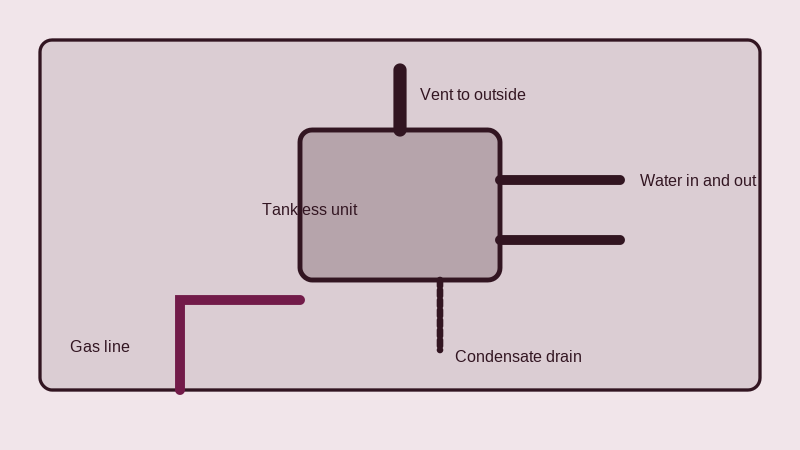
Many people search for a do-it-yourself route after a tank failure because tankless units are efficient. The unit is only part of the job: gas sizing, the exhaust vent, condensate drain and water connections all count, and manufacturers often tie their warranty to correct installation. Check with City of Thousand Oaks Building and Safety before attempting any gas or vent change. What the work includes is shown in our guides to gas tankless installation and tankless installation cost.
At what point should I bring in a plumbing business?
Hire one for a leak from the tank body, any gas smell, any leak you cannot trace, a relief valve that keeps discharging, or any plan to switch fuel type or fit a tankless unit. Gas work and permits are not DIY, and a tank leak calls for a replacement quote.
Send the quote form and we hand the request to a local plumber, who then visits. Say where the water is coming from, whether the heater runs on gas or electricity, its age and what you have shut off. Take a photo of the data label on the tank. Until the plumber arrives, keep the supply closed and the unit off, and protect the floor.
Common questions
How long does a water heater leak repair take?
Tightening a fitting or connector usually takes under an hour, and a drain or relief valve swap takes about as long. A full tank replacement runs several hours. Time grows when the heater is hard to reach or needs venting changes, and the plumber gives an estimate once the leak source is known.
What should I ask a plumber about a heater leak?
Find out whether the plumber will confirm the leak's origin before quoting, what the quote covers for parts, labor, haul-away and permits, and what follows if the tank turns out to be the source. Get the price in writing and confirm which business will do the work.
Should I be at home for the repair?
Yes. The plumber has to reach the heater and the shutoffs, and you should see what failed and agree on the cost. If you are unable to be there, name an adult and tell us when you submit your request. Clear a path to the heater beforehand and keep pets away from the work area, so the job goes quickly and safely.
Is a small water heater leak a danger?
It can be. Water near electrical parts is a shock risk, a gas heater adds fire and carbon monoxide concerns, and a weeping tank can fail suddenly. Close the supply and power or gas, and do not stand in water around the unit. Small leaks tend to grow.
Does home insurance ever cover a water heater leak?
Sometimes, when the loss was sudden, such as a tank bursting. Slow leaks and wear are often excluded. Read your policy and, if possible, keep photos and the old unit. The general idea is explained in insurance and burst pipe damage.